Cleaning a range hood filter means removing built-up grease and debris from baffle, mesh, or charcoal filters to restore airflow and reduce fire risk. For busy kitchens across All Over Ontario, a clean range hood filter boosts capture efficiency, cuts smoke, and protects staff. This guide shows fast, safe steps and when to schedule a professional Filter Cleaning & Exchange.
By Robinhood Cleaners · Last updated: 2026-06-09
Summary
To clean a range hood filter, remove it, degrease with a non-caustic cleaner, soak in hot water, scrub, rinse, dry fully, and reinstall. In high-volume commercial kitchens, inspect filters daily and clean weekly; replace or exchange damaged filters immediately to maintain airflow and reduce fire hazards.
Running a safe, efficient cookline starts with consistent hood filter care. In our experience, fry-heavy operations see visible grease within 40–60 hours of runtime, and many chains standardize weekly filter cleaning for reliability. Here’s what you’ll learn and how to apply it in your kitchen today.
- What range hood filters are and how they protect airflow and fire safety
- Why clean filters matter for capture efficiency and staff comfort
- Exactly how to clean baffle and mesh filters, step by step
- When to exchange filters and how Robinhood Cleaners supports you
- Best practices, tools, checklists, and a quick-reference table
Prefer a done-for-you schedule? Our team coordinates after-hours service across All Over Ontario so your line never slows down during service.
What is a range hood filter?
A range hood filter is a removable barrier—usually baffle or mesh—that captures grease-laden vapors before they enter ducts and fans. Clean filters keep airflow strong, reduce smoke, and lower fire risk. Commercial kitchens use baffle filters most often; mesh and charcoal appear on residential or recirculating setups.
Filters sit at the intake of your hood to knock out airborne grease and particulates. As grease accumulates, resistance rises and capture efficiency drops. That’s when smoke lingers, odors stick, and staff notice hot, hazy air. A consistent routine to clean range hood filter components prevents these issues and supports safer operations.
- Baffle filters: Interlocking blades force a rapid direction change, causing grease droplets to separate and drain into a trough.
- Mesh filters: Multiple wire layers trap grease; they clog faster and require gentler scrubbing to avoid damage.
- Charcoal filters: Used in recirculating hoods to reduce odors; they are not washable and must be replaced.
When paired with routine hood and vent cleaning, well-maintained filters stabilize airflow and reduce load on fans and ducts.
Why cleaning your hood filter matters
Clean filters maintain capture efficiency, reduce smoke and odors, and lower the chance of grease ignition. In practice, kitchens with clean filters report steadier temperatures on the line, fewer complaints, and easier compliance audits. Dirty filters strain fans, increase energy use, and push grease into ducts.
Here’s the thing: your hood can only capture what it can pull. If filters restrict airflow, vapors bypass the canopy, settle on equipment, and increase sanitation workload. In our Ontario routes, we see amber discoloration on filters after 1–2 weeks of daily frying; by 3–4 weeks, pressure drops become noticeable at the cookline.
- Fire safety: A clean range hood filter reduces the fuel available inside the canopy. Grease-soaked media can flare during high heat events.
- Air quality: Better airflow keeps smoke and aerosols from drifting into service areas, improving staff comfort and guest experience.
- Equipment longevity: Unrestricted airflow lowers fan strain and helps maintain designed capture velocities.
- Audit readiness: Grease control is a visible compliance signal during inspections.
If your team is fighting haze by mid-shift or noticing persistent odors, make filter cleaning your first intervention before adjusting fan speed or scheduling duct service.
How hood filters and capture actually work
Hood filters work by redirecting and slowing hot, grease-laden vapors so droplets separate and drain. When filters are clean, air passes at design velocity and the hood captures more plume. As filters clog, resistance rises, capture drops, and smoke escapes into the kitchen.
Effective capture is a balance of hood geometry, fan speed, and filter cleanliness. Baffle blades force air to change direction, causing inertia-driven droplet separation. That’s why keeping blades free of polymerized grease makes such a difference—each clean blade edge promotes separation and drainage.
- Capture velocity: The airspeed at the hood face; clogging reduces velocity and capture effectiveness.
- Plume dynamics: Fryers and grills release buoyant, fast-rising plumes. Clean filters help the hood “grab” those plumes before they roll out.
- Drainage path: Baffle filters drain to a trough; blocked passages trap grease and create hotspots.
We often see a 10–20% perceived improvement in capture after a proper filter service because staff experience fewer smoke rollouts during peak heat. Pair this with scheduled exhaust filter cleaning guidance to keep performance consistent.
Types of filters and cleaning methods
Use non-caustic degreasers and hot water for stainless baffle and mesh filters; replace charcoal filters. Avoid high-alkaline oven cleaners on aluminum media. For heavy soil, soak 15–30 minutes, then scrub with a nylon brush, rinse hot, and air-dry fully before reinstalling.
Different filters call for different handling. Stainless baffles tolerate more agitation, while aluminum mesh dents and oxidizes easily. Recirculating (ductless) hoods depend on charcoal pads for odor control; those must be exchanged on schedule.
- Stainless baffle: Soak in hot water plus food-safe degreaser 15–30 minutes; scrub channels; rinse hot.
- Aluminum mesh: Use mild degreaser; avoid caustic products and long soaks; rinse gently; pat dry to limit oxidation stains.
- Charcoal (carbon): Not washable; replace per manufacturer schedule or when odor control fades.
When filters are warped, cracked, or missing drain holes, exchange them—cleaning won’t fix compromised geometry. Our team handles filter type comparisons and exchanges during off-hours service windows.
Step-by-step: how to clean a range hood filter
Remove the filter, pre-rinse with hot water, apply degreaser, soak 15–30 minutes, scrub baffles or mesh, rinse until water runs clear, dry completely, and reinstall. Inspect gaskets and frames as you go. Log the date and soil level to optimize your cleaning schedule.
- Shut down and cool: Power off nearby burners; let metal cool to avoid burns.
- Remove filters: Slide baffles or unclip mesh panels. Note their orientation.
- Pre-rinse hot: 120–140°F water loosens oils and speeds degreasing.
- Degrease: Apply a non-caustic, food-safe degreaser. Avoid harsh alkali on aluminum mesh.
- Soak: Submerge 15–30 minutes depending on soil. Extremely heavy buildup may need 45 minutes.
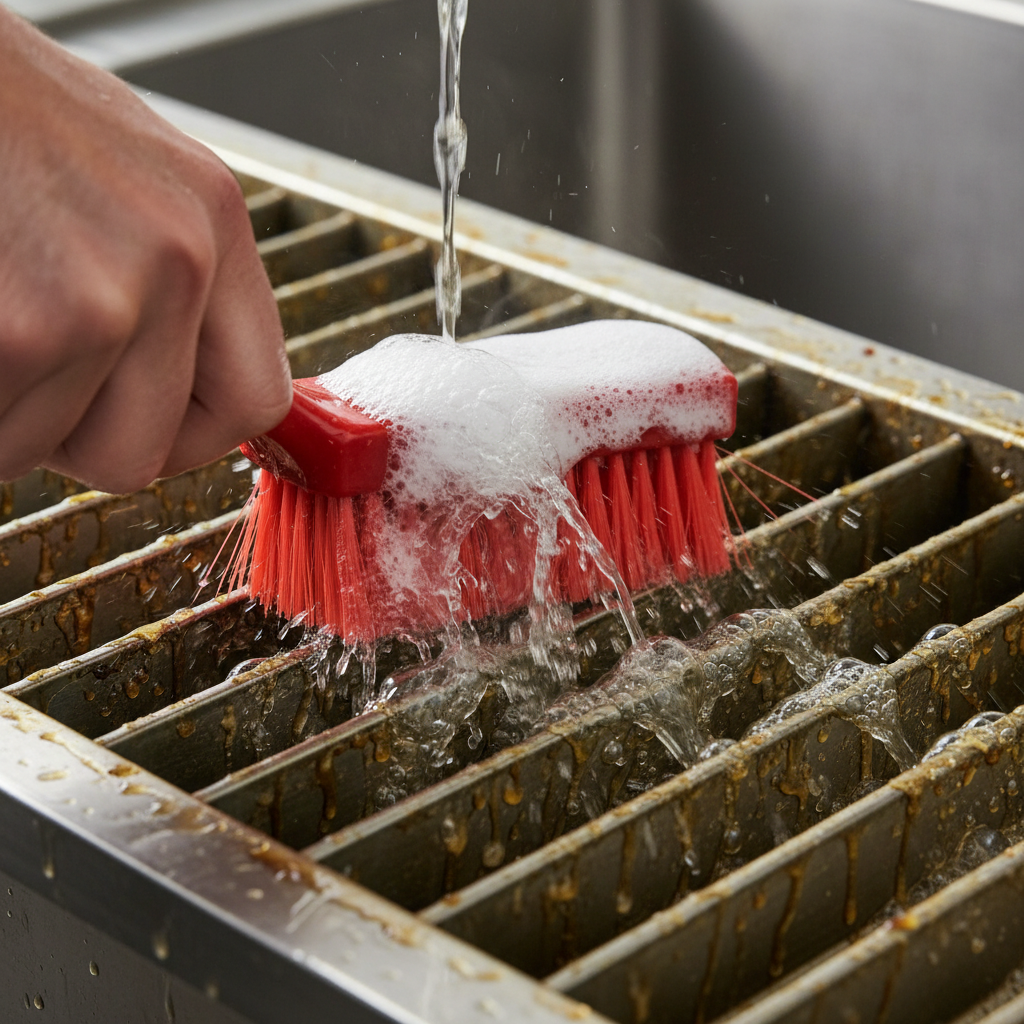
- Scrub: Use a stiff nylon brush for baffles; soft brush for mesh. Clean drain channels and corners.
- Rinse hot: Continue until runoff is clear and residue-free.
- Dry fully: Air-dry upright 30–60 minutes; confirm no standing water in channels.
- Reinstall: Return filters in the original orientation; check for secure seating and proper pitch.
- Log service: Record soil level (light/medium/heavy) and next cleaning date.
| Soil level | Soak time | Brush type | Reclean interval |
|---|---|---|---|
| Light (fresh film) | 10–15 min | Soft/nylon | 7–14 days |
| Medium (amber) | 20–30 min | Nylon, detail brush | 7 days |
| Heavy (polymerized) | 30–45 min | Nylon + scraper edges | 3–5 days until stabilized |
If you’re short on space or staff, a professional exchange program keeps clean stock on rotation so you never miss a cycle. See our quick-reference on keeping extractor filters clean for additional details.
Best practices that save time and reduce risk
Standardize a weekly filter cycle, label clean and dirty racks, and log every service. Keep spares on hand to avoid downtime. Use non-caustic degreasers, hot water, and nylon brushes. Replace any warped or cracked filters immediately—cleaning won’t restore damaged geometry or fire performance.
We’ve found the most reliable kitchens run a color-coded or labeled rack system. Teams swap in clean filters at close, then clean the used set the next morning. That keeps service time focused on cooking, not scrubbing, and yields steadier capture during the dinner rush.
- Set a fixed cadence: Many QSRs succeed with weekly cycles; high-fry volume may need twice-weekly.
- Stage spares: Keep one full spare set per hood section.
- Choose safer chemistry: Food-safe, non-caustic degreasers protect metal and staff.
- Log it: A simple wall chart or digital log tightens accountability.
- Pair with hood service: Align filter cycles with periodic hood and duct cleaning to control total grease load.
When labor is tight, our Filter Cleaning & Exchange program covers pickup, deep clean, and drop-off so your team stays on the line.
Tools and resources you’ll need
For stainless baffles: non-caustic degreaser, 120–140°F water, nylon brushes, gloves, eye protection, drying rack, and a log sheet. For aluminum mesh: milder cleaner and soft brush. For charcoal pads: replacement stock and a documented change schedule.
- Degreaser: Food-safe, non-caustic product compatible with stainless and aluminum.
- Brush kit: Stiff nylon (baffles), soft nylon (mesh), and corner detail brush.
- Hot water source: The hotter the rinse (within safety limits), the faster the release.
- Drying rack: Upright airflow prevents water pooling in channels.
- Spare set + labels: Enables swap-and-go routines and prevents missed cycles.
- Service log: Date, soil level, technician initials, next due date.
Need a starter template? Our team shares filter logs during onboarding, and we can align them with your NFPA-focused compliance schedules.
When to replace or exchange filters
Exchange or replace filters when they’re warped, cracked, heavily dented, or when grease has polymerized into a hard varnish you can’t remove. If charcoal pads no longer control odors, replace them. A spare set prevents downtime and keeps capture efficiency consistent.
In our experience, baffle frames that no longer sit square allow bypass and hotspots. Mesh that deforms loses surface area and clogs unevenly. At that point, exchanging filters restores airflow faster than repeated deep cleans.
- Visual cues: Warped frames, missing screws, cracked corners, or clogged, immovable varnish.
- Operational cues: Persistent smoke rollouts, odors after cleaning, or fans running louder than usual.
- Schedule cues: If clean cycles creep from weekly to every 2–3 days, it’s time to exchange.
Explore our overview of extractor filter upkeep and our guidance on replacement schedules to plan proactively.
Mini case studies: what works in Ontario kitchens
The fastest improvements come from a spare-set swap, weekly cleaning cadence, and coordinated after-hours service. Teams report less smoke, steadier temperatures, and fewer call-backs when filters are logged and aligned with scheduled hood and duct maintenance.
Quick-service grill line: A QSR in All Over Ontario struggled with haze by lunch. We staged a spare baffle set, set twice‑weekly cleaning, and aligned with quarterly hood service. Within two weeks, staff reported clearer sightlines and fewer smoke alarms during peak sizzle periods.
High-volume fryer bank: An institutional kitchen running 11 a.m.–8 p.m. saw amber filters after three days. We implemented a weekday cleaning loop and monthly inspection. Capture stabilized, and exhaust fan noise (a proxy for strain) dropped noticeably after each swap.
Catering kitchen with ductless hood: Odor lingered post-event. Charcoal pads were nine months old and saturated. Swapping the carbon media restored odor control immediately; we set a 90–120 day change schedule based on use.
For more structured guidance, see our internal deep dives on exhaust filter cleaning and kitchen exhaust hood service.
Safety and compliance signals auditors look for
Auditors check for clean, undamaged filters, intact hood labels, accessible fire suppression components, and documented cleaning intervals. Visible grease at the hood face, missing filters, or warped panels raise immediate concerns and can trigger follow-up actions.
While full-code references vary by jurisdiction, the practical bar is clear: keep grease under control, document intervals, and protect airflow. Inspectors consistently focus on evidence—clean surfaces, dated logs, and reliable service partners. Our team supports after-hours hood cleaning and documented filter exchange so your book is audit-ready.
- What we document: Filter condition, soil level, actions taken, next due date, and technician signature.
- Common flags: Filters installed backward, missing drain holes, visible varnish, or saturated charcoal.
- Next steps: If flags appear twice in a row, we recommend an exchange and a hood service alignment.
Local considerations for All Over Ontario
- Plan filter swaps around winter closings and patio season ramp-ups; volume shifts 20–30% can change your cleaning cadence.
- Schedule after-hours pickups to avoid morning prep crunch—our team is available 24/7 to match service windows.
- Grease loads spike during festival and holiday catering. Stage an extra spare set to prevent missed cleanings under peak demand.
Troubleshooting: common problems and quick fixes
If smoke escapes the hood, first clean or swap filters, then check orientation, gaps, and hood baffle pitch. Persistent issues point to fan speed, make-up air balance, or duct restrictions—schedule a full hood and duct inspection if filter fixes don’t restore capture.
- Smoke rollouts after cleaning: Ensure filters aren’t backward; confirm a slight pitch toward the trough.
- Lingering odor: Replace charcoal pads; confirm regular cleaning of baffles/mesh.
- Fan noise up, airflow down: Filters likely over-soiled or warped; exchange and reassess.
- Grease drips at the hood face: Drain channels are clogged; deep clean and verify alignment.
If duct static pressure is trending up despite clean filters, it’s time to align your filter cycle with professional hood cleaning and, if needed, NFPA-focused maintenance planning.
Checklists and templates you can use
Use a one-page filter log: date, soil level, initials, next due. Pair it with a weekly calendar reminder and a spare-set label system. Keep a laminated “how-to” card near the dish area showing soak times, brush types, and safety notes.
- Daily: Inspect filters at close; swap if amber or sticky.
- Weekly: Full clean cycle for baffles/mesh; sanitize drip trays.
- Monthly: Inspect frames for warping; verify charcoal pad dates.
- Quarterly: Align with hood and duct service; tighten screws and replace worn gaskets.
Want our laminated card template? Ask our team during onboarding—we’ll align it to your line layout and filter type.
Need a hand keeping filters on schedule?
Our Filter Cleaning & Exchange program keeps your hood running at peak capture with zero downtime. We supply a spare set, schedule after-hours swaps, deep-clean offsite, and document every visit to keep you audit-ready.
Let’s make the haze disappear. Book a quick assessment and we’ll map the right cadence for each hood section. We operate 24/7 across All Over Ontario and coordinate around prep and service windows.
Tools in action: see the difference
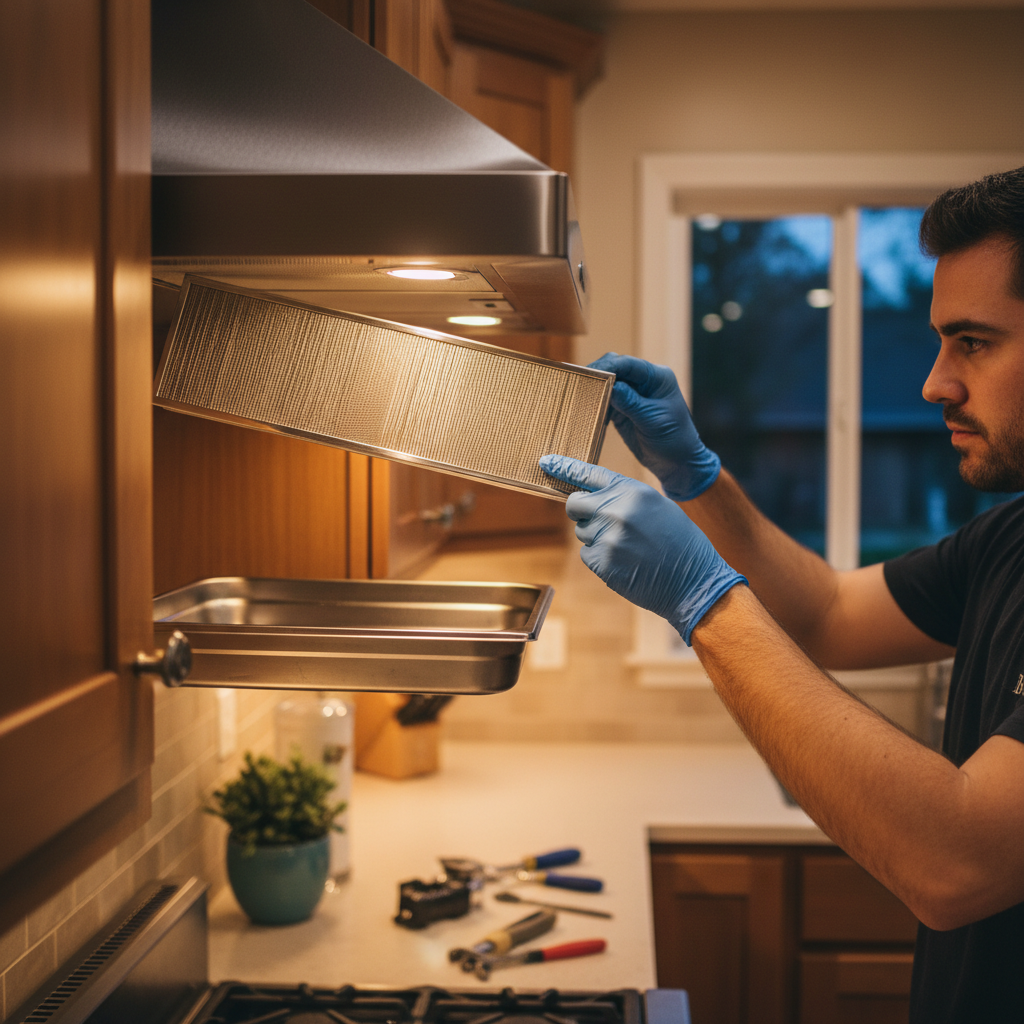
A hot rinse, correct chemistry, and the right brush remove polymerized grease faster than repeated light scrubs. With a spare-set rotation, teams finish swaps in minutes, and measured capture improves because filter resistance stays low during service hours.
Take five minutes to compare a new filter to your in-service set under bright light. If channels look matte and sticky, it’s time. For a deeper dive, our short internal writeups on why clean hood filters matter and what a proper cleaning includes will help you calibrate the schedule by station.
Frequently Asked Questions
Most commercial hoods use stainless baffle filters that you can wash and rotate weekly; aluminum mesh needs gentler cleaning; charcoal pads must be replaced. If smoke or odor persists after cleaning, exchange filters and schedule a hood inspection.
How often should I clean a commercial range hood filter?
Most fry or grill lines benefit from weekly cleaning. High-volume frying can require twice weekly. If filters turn amber or feel sticky midweek, add a mid-cycle rinse or switch to a spare-set exchange to keep capture steady.
Can I put baffle filters in a dishwasher?
Some stainless baffles tolerate dishwashers, but heavy grease can redeposit. Use hot water plus a food-safe degreaser and manual brushing for best results. Avoid dishwashers for aluminum mesh—they can oxidize and discolor.
When should charcoal filters be replaced?
Charcoal pads aren’t washable. Replace them when odors linger or on the manufacturer’s interval, often every 90–120 days in active kitchens. Keep dated spares on hand to prevent gaps in odor control.
How do I know if a filter is installed backward?
Look for the drain holes and blade orientation. If the blades face the wrong way or holes aren’t aligned toward the trough, airflow is restricted and grease won’t drain properly. Reverse and reseat the panel so it pitches toward the trough.
What if cleaning doesn’t fix smoke and odor?
Swap in a known-clean spare set. If problems persist, the issue may be fan speed, make-up air, or duct restrictions. Align your filter routine with professional hood and duct cleaning to restore designed capture.
Key takeaways
A clean range hood filter restores airflow, reduces smoke, and lowers fire risk. Standardize a weekly cycle, keep spares, and log service. Exchange damaged or saturated filters immediately, and align your routine with periodic hood and duct maintenance for consistent capture.
- Clean baffle/mesh filters with hot water, non-caustic degreaser, and nylon brushes.
- Stage a spare set and label racks to keep swaps under 10 minutes.
- Replace charcoal pads; don’t wash them.
- Exchange any warped or cracked filters; cleaning won’t fix damage.
- Sync with scheduled hood and duct cleaning to stabilize capture.
Related guides and resources
Explore deeper how-tos, filter comparisons, and maintenance schedules. These guides pair with your filter routine to keep capture strong and audits smooth in Ontario kitchens.
For a deeper maintenance plan, see our internal writeups on kitchen hood filter cleaning in Ontario and our Ontario NFPA-focused guidance. For local service snapshots, review our regional overviews: Milton exchange overview, Ontario replacement guide, and Brampton exchange summary.