Cleaning extractor filters is the process of removing grease, carbon, and food particles from commercial range hood baffle or mesh filters to restore safe airflow and reduce fire risk. In All Over Ontario, kitchens rely on consistent filter care to meet safety standards and keep staff breathing easier during rushes.
By Robinhood Cleaners • Last updated: 2026-05-11
Quick Overview and Table of Contents
Extractor filter cleaning prevents grease fires, protects airflow, and keeps your hood system compliant. This guide explains what filters do, how cleaning works, how often to service them, proven methods, and professional best practices tailored to busy Ontario kitchens.
Here’s what you’ll learn and how to navigate this complete guide quickly:
- What extractor filters are and how they capture grease
- Why routine service reduces fire risk and downtime
- How professional cleaning works step by step
- Methods: soak tanks, dishwasher-safe, manual scrub, exchange
- Scheduling by volume, cuisine type, and hood design
- Tools, detergents, safety gear, and documentation
- Real-world examples from Ontario commercial kitchens
What Is Extractor Filter Cleaning?
Extractor filter cleaning is the professional removal of grease and particulates from hood filters to restore capture efficiency and reduce ignition risk. Clean filters maintain airflow, help ducts stay drier, and support NFPA-style fire safety practices in commercial kitchens.
In commercial kitchens, extractor filters sit in the hood above the cooking line and act as the first line of defense against grease-laden vapors. As those vapors cool inside the filter baffles, they condense and get trapped—protecting ducts and fans from rapid buildup.
- Primary role: Intercept grease before it reaches ducts and fans.
- Safety impact: Less fuel for flash fires and flare-ups under hoods.
- Airflow effect: Clean filters stabilize static pressure and improve capture.
- Compliance value: Supports safer operations aligned with recognized fire-safety guidelines.
For restaurants and institutional kitchens, cleaning extractor filters also extends the life of the entire exhaust system. Dirty filters force fans to work harder, which strains belts, motors, and bearings. Over time, that means more emergency calls and unplanned shutdowns.
Why Cleaning Extractor Filters Matters
Regular filter cleaning reduces fire risk, stabilizes airflow, and protects equipment life. It also supports health and safety compliance and keeps odors down—critical wins for busy commercial kitchens.
Here’s why the practice pays off for Ontario operations with high daily volume:
- Fire hazard reduction: Grease is fuel. Less residue in filters and ducts, less chance of ignition.
- Steadier capture: Clear filters help hoods capture smoke and steam before they drift into dining spaces.
- Lower mechanical strain: Fans don’t labor against clogged intake, protecting belts and motors.
- Cleaner air for staff: Better ventilation helps reduce cooking aerosols and odors.
- Better inspections: A documented schedule shows diligence and helps pass audits.
In our experience supporting quick service and fine dining teams All Over Ontario, most airflow complaints trace back to loaded filters. Stabilizing filter care often improves capture within a single service cycle, and the difference is noticeable on the line.
To go deeper on exhaust passages that sit beyond the filters, see our note on system benefits in this resource from our team: exhaust duct cleaning benefits.
How Extractor Filter Cleaning Works
The process removes filters, pre-scrapes heavy soil, soaks in a hot alkaline degreaser, agitation-rinses, then dries and reinspects. Professionals document condition, reinstall safely, and verify airflow stability before handoff.
Professionally cleaning extractor filters follows a predictable workflow designed for speed, safety, and repeatability during off-hours:
- Preparation and safety: Lockout of cooking appliances, protect surfaces, verify hood cool-down, and gear up (gloves, eye protection).
- Removal and staging: Pull filters, tag stacks by hood position, and pre-scrape or wipe heavy soils to reduce tank load.
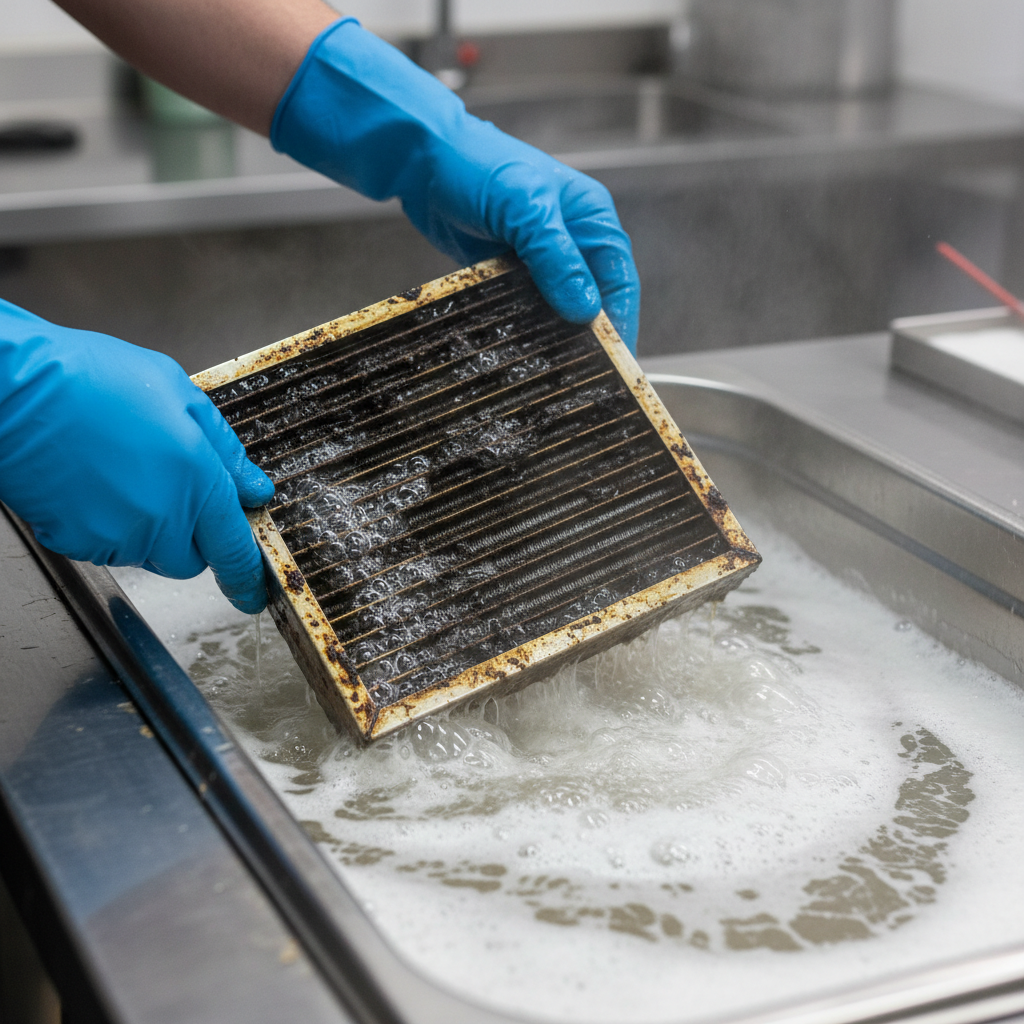
- Hot soak degreasing: Submerge filters in a calibrated alkaline solution. Heat and chemistry break down polymerized grease.
- Agitation and rinse: Agitate or pressure rinse to dislodge residue; repeat soak for stubborn sections.
- Dry and inspect: Air-dry or towel-dry; check for warping, broken welds, or clogging in channels.
- Reinstall and verify: Seat filters with baffles vertical, confirm secure fit, then verify hood draw.
- Document and schedule: Note condition, set next cleaning based on volume and cuisine.
Many Ontario kitchens combine this with a scheduled filter exchange program to keep clean spares on hand. For a deeper planning guide tailored to regional operations, review our filter replacement schedule reference.
Types of Filters and Cleaning Methods
Most commercial hoods use stainless baffle filters; some legacy systems still use mesh. Cleaning options include hot-soak tanks, commercial dishwashers, manual scrubbing, ultrasonic systems, and professional filter exchange programs that swap dirty for clean on a set cadence.
Common filter types
- Stainless baffle filters: Preferred for fire safety and durability; channels capture grease by inertia and condensation.
- Aluminum baffle filters: Lightweight but can react to strong alkalis—use compatible chemistry and lower heat.
- Mesh filters (legacy): Higher restriction when dirty; prone to deformation; consider upgrading to baffles.
Method comparison (at-a-glance)
| Method | Best For | Pros | Watchouts |
|---|---|---|---|
| Hot soak tank + rinse | Heavy, polymerized grease | Thorough, repeatable, scalable overnight | Requires safe chemical handling and ventilation |
| Commercial dishwasher | Light-to-moderate soil | Fast, uses existing equipment | May not fit large baffles; can redeposit soils if overloaded |
| Manual scrub + degreaser | Spot cleaning or mid-shift touch-ups | Targeted; no special gear | Labor-intensive; inconsistent without training |
| Ultrasonic cleaning | Complex geometries or delicate mesh | Excellent penetration | Requires dedicated equipment and controls |
| Filter exchange program | High-volume kitchens needing zero downtime | No on-site soak; instant swap keeps line moving | Requires managed inventory and logistics |
Curious which approach fits your operation? Our Ontario-focused guide on replacements offers additional context: filter replacement in Ontario.
Best Practices: Cleaning Extractor Filters Without Disruption
Standardize your cadence, choose the right method for your menu, and document each cycle. Align filter care with hood, duct, and fan maintenance to lower fire risk and equipment strain while keeping service uninterrupted.
Scheduling that actually works
- High-volume fry and grill lines: Plan weekly to biweekly cycles.
- Mixed or moderate menus: Biweekly to monthly cycles are typical.
- Low-volume or light cooking: Monthly to six-week cycles often hold.
Set up a smooth rotation
- Tag by hood position: Keep stacks in sequence to speed reinstall.
- Hold clean spares: An exchange set prevents rush-hour surprises.
- Inspect as you go: Look for dents, warping, or clogged channels.
Pair with total-system care
- Coordinate with duct cleaning schedules to keep passages clear.
- Ask for a hood draw check and belt look-over during filter service.
- Log findings and photos in a simple binder or cloud folder.
For guidance tailored to Ontario fire-safety expectations, see our practical overview: Ontario hood safety guidance.
Local considerations for All Over Ontario
- Plan deep cleans after long weekends and holiday rushes when grease load peaks in regional QSR corridors.
- Winter ventilation: cold air makeup can reduce capture. Keep filters pristine to maintain draw during temperature swings.
- Late-night service windows help avoid downtime; our team provides 24/7 scheduling to match Ontario operations.

Tools, Detergents, and Documentation You’ll Need
Use stainless-safe alkaline degreasers, heat-resistant soak tanks, PPE, and non-marring brushes. Pair with labeling tags, a rotation tracker, and photo logs. The right kit speeds cleaning while protecting filter welds and finishes.
Core cleaning kit
- Soak tank or deep sink: Sized for your largest baffles; insulated helps hold temperature.
- Alkaline degreaser: Stainless-compatible chemistry; follow dwell-time directions.
- Soft-bristle brushes: Non-marring to protect channels and seams.
- PPE: Gloves, eye protection, aprons, and slip-resistant footwear.
- Rinse tools: Spray nozzles or controlled pressure washing for final removal.
Protection and tracking
- Surface protection: Mats and plastic to guard floors and nearby equipment.
- Tagging system: Color or number tags to map filters back to positions.
- Rotation log: Keep a binder or digital sheet with dates, methods, and inspector initials.
For kitchens that need zero on-site soaking, a managed exchange can help. Explore practical swap scenarios in this regional overview: Ontario 2026 replacement guide.
Case Studies and Ontario Examples
In Ontario kitchens, filter cycles vary by menu and hours. Swapping or cleaning every 1–2 weeks on high-grease lines stabilizes capture, while monthly rotations often suit mixed menus. Photo logs and simple tags cut reinstall time and reduce rework.
Quick service grill line
- Challenge: Capture loss during dinner rush; smoke drifting to order counter.
- Action: Installed spare set; moved to weekly hot-soak with baffle inspection.
- Result: Noticeable draw improvement within one cycle; fewer belt issues.
Hotel banquet kitchen
- Challenge: Irregular events created uneven grease loads.
- Action: Adopted exchange program before/after peak weekends; added rotation log.
- Result: Consistent airflow reported; less odor migration to pre-function areas.
Campus food court
- Challenge: Multiple small lines with mixed menus; limited overnight access.
- Action: Biweekly manual scrub + monthly soak; standardized tag map by kiosk.
- Result: Faster reinstall and fewer misplaced filters across vendors.
If you’re exploring hood and system-wide service planning, this overview might help: restaurant exhaust cleaning GTA.
How Filter Cleaning Fits With Your Whole Exhaust System
Clean filters protect ducts, fans, and belts. Pairing filter care with duct and hood cleaning reduces grease load system-wide, improves draw, and supports safer operation across your entire ventilation path.
Filters are step one. But the grease they don’t catch lands in the hood plenum, horizontal and vertical ducts, and finally the fan housing. Keeping those passages clear helps fans move air at the designed rate and prevents oily residue from dripping back onto equipment.
- Coordinate with routine hood degreasing and plenum wipe-downs.
- Schedule duct cleaning to match volume and menu.
- Ask for a quick fan belt look as part of service to reduce mid-rush surprises.
For specific replacement planning in Ontario hubs, see this example scenario: Brampton filter replacement guide.
Step-by-Step: A Safe DIY Mid-Shift Touch-Up
For light soil between professional services, do a short, safe touch-up: cool down, remove, spray a stainless-safe degreaser, gently brush, rinse, dry, and reinstall. Reserve heavy soil for professional hot-soak or exchange.
- Cool and power down: Let cooking surfaces and the hood area cool. Wear gloves and eye protection.
- Remove carefully: Pull baffles out by tabs; stage on protected surfaces.
- Apply cleaner: Use a stainless-safe spray; avoid aluminum-reactive products if applicable.
- Brush lightly: Move with the channels; don’t bend fins.
- Rinse and dry: Use warm water; dry thoroughly to prevent drip-back.
- Reinstall: Seat baffles with channels vertical; check for firm engagement.
When filters show baked-on soil or warping, skip DIY and schedule a hot-soak or exchange cycle. That protects welds and keeps your capture stable for the next rush.
Troubleshooting and Quality Checks
If capture drops, check filter orientation, cleanliness, gaps, and fan performance. Fixing a reversed baffle or swapping a clogged panel often restores draw immediately.
- Orientation: Baffles must be vertical; reversed panels leak and whistle.
- Gapping: No visible holes between filters; fill with correct size panels.
- Condition: Replace dented, warped, or split-weld filters.
- Fan support: Listen for belt slip; look for vibration or oil drips.
Need a planning overview for Ontario teams? This quick read covers the basics of scheduling and safety context: Ontario filter planning.
Frequently Asked Questions
Most kitchens benefit from weekly to monthly filter cleaning depending on menu and hours. Use stainless-safe degreasers, verify orientation on reinstall, and pair with periodic duct and hood service for consistent capture and safety.
How often should I be cleaning extractor filters in a busy fryer and grill line?
Weekly cycles are common for heavy fry and grill programs. Some teams rotate mid-week touch-ups plus a deeper hot-soak on off-nights. If smoke or steam escapes the hood, shorten the interval or add an exchange set.
Can I run baffle filters through a commercial dishwasher?
Yes for light-to-moderate soil and stainless filters, provided the racks fit. Avoid overloading, and verify your chemistry is stainless-compatible. Heavy, baked-on residue needs a hot-soak degreaser bath or professional exchange.
What’s the right orientation when reinstalling?
Install with the baffle channels vertical so grease drains properly. Make sure there are no gaps between filters. A reversed or loosely seated panel can whistle, leak, and hurt capture performance immediately.
When should I replace instead of clean?
Replace dented, warped, or split-weld panels and any filters that stay stained or clogged after a proper hot-soak. If cleaning takes too long or disrupts service, a managed filter exchange program is often the better option.
Conclusion and Next Steps
Make extractor filter care a routine: set a cadence, choose a proven method, and document each cycle. Pair with hood, duct, and fan service for stable airflow and lower fire risk—especially in high-output Ontario kitchens.
- Key takeaways: Clean filters improve capture, cut fire risk, and protect equipment.
- Action now: Map a weekly, biweekly, or monthly rotation based on grease load.
- Stay consistent: Add tags, photo logs, and a simple binder to keep teams aligned.
- Think system-wide: Align with hood and duct cleaning cycles.
Ready to streamline cleaning extractor filters and reduce mid-rush headaches? Our Ontario team is available around the clock. Explore swap options here for local operations: Ontario replacement overview or see this regional example: Brampton replacement outline.