You run a busy line. Grease flies, tickets stack, and safety can’t slip. A kitchen exhaust filter replacement schedule is the quiet system that keeps airflow strong, fire risk low, and health inspectors satisfied—night after night across Ontario kitchens.
- What you’ll learn in this complete guide:
- • The exact elements of a practical kitchen exhaust filter replacement schedule
- • How to align with NFPA 96 and health inspection expectations
- • Step-by-step scheduling methods you can implement this week
- • When to clean, when to replace, and how to document it
- • Local tips for Ontario operations with quick-turn service needs
Summary
- • Filters capture grease before it enters ducts; clogged filters raise fire risk and strain fans.
- • A replacement and cleaning cadence should be tailored to cooking volume, fuel type, and menu.
- • NFPA 96 requires routine maintenance; your logbook and proof of service matter as much as the work.
- • Robinhood Cleaners supports Filter Cleaning & Exchange, Hood & Duct Cleaning, and 24/7 scheduling across Ontario with fast response in Southern Ontario.
Quick Answer
For most Ontario restaurants, set a kitchen exhaust filter replacement schedule by checking filters daily, cleaning or exchanging weekly to biweekly, and fully replacing every 6–12 months depending on volume. Robinhood Cleaners (serving All Over Ontario) provides NFPA 96–aligned Filter Cleaning & Exchange and 24/7 service to keep you compliant and safe.
Table of Contents
- What Is a Kitchen Exhaust Filter Replacement Schedule?
- Why Your Schedule Matters (Safety, Compliance, Uptime)
- How Scheduling Works: Step-by-Step
- Filter Types & Replacement Methods
- Best Practices That Pass Inspections
- Tools, Checklists, and Resources
- Ontario-Specific Considerations
- Real-World Examples (12 Scenarios)
- Common Mistakes to Avoid
- FAQ
- Conclusion + Key Takeaways
What Is a Kitchen Exhaust Filter Replacement Schedule?
Think of it as your kitchen’s breathing plan. Filters are the first line of defense, trapping grease before it migrates into hoods, ducts, and the rooftop fan. A schedule sets who checks, cleans, exchanges, and replaces filters—and when.
- • Core components of a schedule:
- — Daily visual checks for warping, saturation, and airflow issues.
- — Routine cleaning or exchange cadence (weekly to biweekly for most fry/grill lines).
- — Full replacement interval (6–12 months for typical operations; sooner for heavy fryers).
- — Documentation in a logbook or digital tracker aligned to NFPA 96 expectations.
- — Escalation protocol for damaged filters (immediate swap + hood/duct inspection).
- • Where this connects: Hood Cleaning, Duct Cleaning, and Fan Cleaning reduce downstream risk. Filter upkeep is the upstream control that keeps those systems from overwhelming grease loads.
Why Your Schedule Matters (Safety, Compliance, Uptime)
Here’s the thing—filters are small, but their impact is huge. They reduce ignition sources, keep fans running efficiently, and improve air quality for your team.
- • Fire hazard reduction:
- — Clean, intact baffle filters slow flame spread and capture grease effectively.
- — Saturated filters drip grease and can accelerate flashover risk on a busy line.
- • Compliance and inspections:
- — NFPA 96 and local inspectors expect routine maintenance with proof (dated labels, logs).
- — A clear schedule demonstrates due diligence and can streamline re-inspections.
- • Equipment performance:
- — Clogged filters force exhaust fans to work harder, shortening belt and motor life.
- — Better airflow = cooler cooklines, less smoke, and happier staff.
- • Operations and guest experience:
- — Fewer smoke alarms and fewer service interruptions.
- — Less odor migration into dining rooms and hotel corridors.
Most operators don’t realize how quickly filters saturate during peak periods. A consistent kitchen exhaust filter replacement schedule prevents small issues from becoming shutdowns.
How Scheduling Works: Step-by-Step
Build a cadence you can keep. Here’s a simple, repeatable framework we implement with Ontario kitchens of all sizes.
1) Profile your cooking line
- • Menu intensity: High-fry, charbroil, or wok stations saturate fastest.
- • Fuel type: Solid fuel (wood/charcoal) needs tighter controls than gas or electric.
- • Hours of operation: Late-night or 24/7 kitchens require more frequent exchanges.
- • Ventilation design: Long duct runs and underpowered fans raise risk when filters clog.
2) Set your baseline cadence
- • Daily:
- — End-of-shift visual check of every filter bank.
- — Wipe exterior edges to remove surface grease.
- • Weekly to biweekly:
- — Remove, soak, and wash baffle filters or use a professional Filter Cleaning & Exchange service.
- — Rotate spare clean filters back into service.
- • Every 6–12 months:
- — Replace filters showing warping, corroded rivets, loose frames, or persistent staining.
3) Document everything
- • Maintain a logbook with dates, initials, and notes on condition.
- • Keep service reports from NFPA 96–certified vendors with before/after photos.
- • Label banks (A, B, C…) to track rotation patterns and wear trends.
4) Align with system-wide maintenance
- • Pair filter exchanges with Hood Cleaning, Duct Cleaning, and Fan Belt Replacement windows.
- • When airflow drops, validate at the fan and duct, not just the filter bank.
- • Integrate Grease Trap Service cycles to keep plumbing and sanitation aligned.
5) Review and adjust quarterly
- • Seasonal menu changes? Adjust cadence accordingly.
- • New equipment? Reassess airflow and saturation rates.
- • Incident reports? Tighten intervals after any near-miss or alarm event.
| Kitchen Profile | Daily Check | Clean/Exchange | Full Replacement |
|---|---|---|---|
| High-fry, charbroil (late hours) | Each shift | Weekly | 6 months |
| Mixed grill, sauté, ovens | Daily | Biweekly | 9–12 months |
| Light prep/low grease | Daily | Monthly | 12 months |
Need a deeper dive on whether to clean or replace? See our guidance on clean vs. replace filters for signs that indicate a swap is due.
Filter Types & Replacement Methods
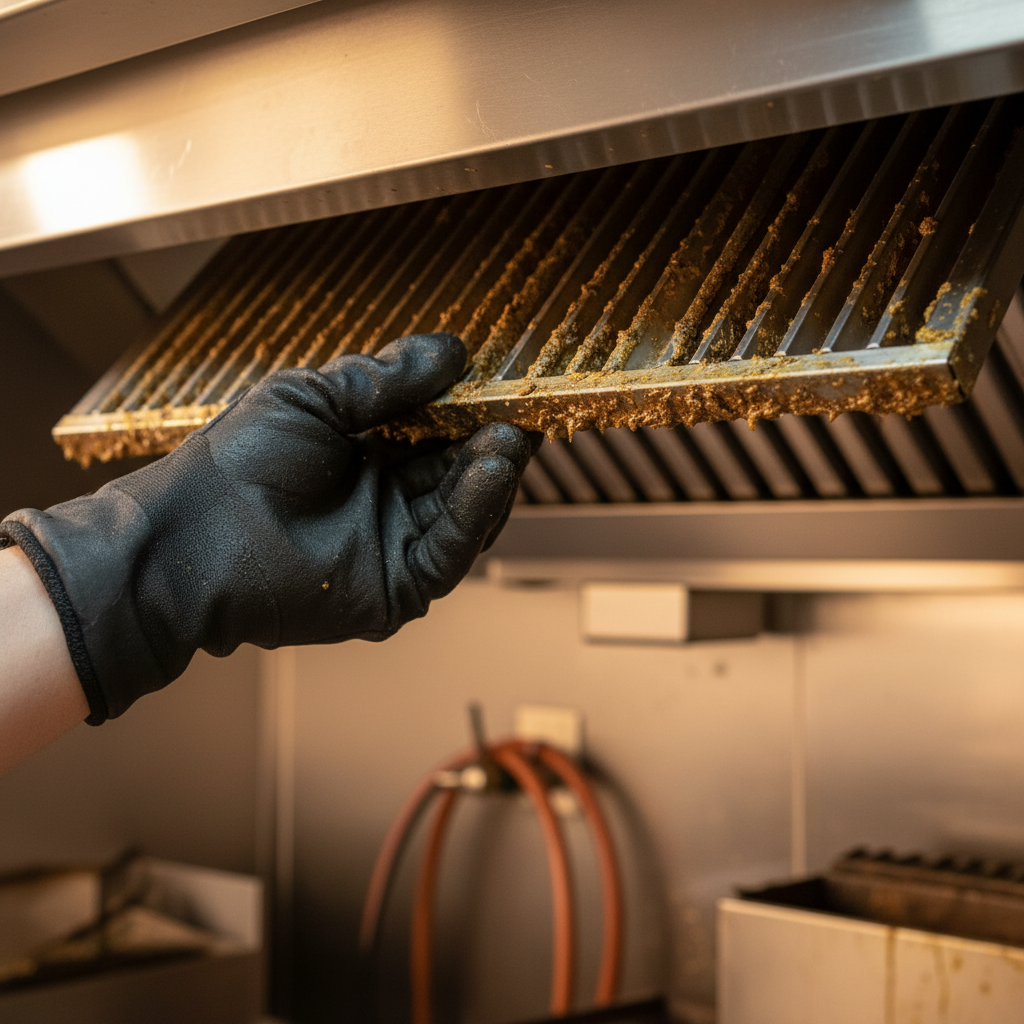
Not all filters behave the same. Choosing the right baffle and the right replacement method will make or break your schedule.
- • Stainless baffle filters (industry standard):
- — Durable, efficient at capturing grease, dishwasher-friendly.
- — Inspect for bent baffles, loose welds, or frame damage after drops.
- • Aluminum baffle filters:
- — Lightweight, lower cost, but can pit and deform faster in caustic solutions.
- • Galvanized options:
- — Budget choice; coating can wear with aggressive degreasers.
- • Spark arrestor inserts (solid fuel lines):
- — Required for wood/charcoal stations; clean more often and replace sooner.
Replacement approaches
- • In-house clean and rotate:
- — Keep a spare set on site; rotate weekly/biweekly.
- — Use proper soak tanks and NSF-rated degreasers; rinse thoroughly.
- • Professional Filter Cleaning & Exchange:
- — Vendor picks up saturated filters and installs a clean set on a fixed cadence.
- — Includes inspection notes, photos, and condition tracking for compliance.
- • Full replacement:
- — Replace when metal fatigue, warping, or persistent staining compromises airflow.
Best Practices That Pass Inspections
Inspections focus on process and proof. Build these into your routine to satisfy NFPA 96 and local health authorities.
- • Label every filter bank with a simple code (A1, A2, B1…).
- • Use dated tags or a whiteboard in the dish/pot area to note exchange dates.
- • Keep a bound or digital logbook with signatures and photos.
- • Store clean filters upright to drain before installation.
- • Point arrow engravings the correct direction for grease capture and airflow.
- • Pair filter cycles with prevent exhaust fires protocols—hood, duct, and fan cleaning on cadence.
- • Train closing crews to do end-of-night visual checks; empower them to escalate.
- • After any flare-up, replace affected filters and schedule an immediate hood/duct review.
Tools, Checklists, and Resources
Simple tools make schedules stick. Here’s a practical kit list used by Ontario kitchens we support.
- • Supplies for in-house cleaning:
- — NSF-rated degreaser, soak tank or bus tubs, nylon brushes, PPE (gloves, goggles, aprons).
- — Stainless drying rack; absorbent mats to prevent slip hazards.
- • Tracking and reminders:
- — Shared calendar with recurring tasks (weekly/biweekly).
- — Label printer or dry-erase board for quick visual cues.
- • Professional services (when you need backup):
- — Complete filter replacement guide with scheduling insights.
- — NFPA 96–aligned Filter Cleaning & Exchange, Hood & Duct Cleaning, Fan Cleaning, and Grease Trap Service from Robinhood Cleaners.
- — 24/7 availability with fast response in Southern Ontario for after-hours exchanges.
Local Tips
- Tip 1: If you’re along the 401/403 corridor, schedule exchanges after the dinner rush to avoid highway delays and keep your hood running clean by the next lunch service.
- Tip 2: Summer heat in Southern Ontario pushes fan motors harder; tighten your biweekly filter rotation to weekly during heat waves or festivals.
- Tip 3: For hotels and campuses with multiple outlets, standardize one logbook format across sites—Robinhood Cleaners can sync schedules and provide one consolidated report for inspectors.
IMPORTANT: These tips reflect real service patterns across All Over Ontario and pair well with our 24/7 Filter Cleaning & Exchange support.
Ontario-Specific Considerations
Operations across Ontario face similar standards but different realities day-to-day. Build your schedule with local nuance.
- • Weather swings: Winter road salts and slush mean more rooftop debris; confirm fan access is safe and filters are dry before install.
- • Seasonal festivals: Pop-up volume spikes saturate filters faster—temporary weekly exchanges keep airflow steady.
- • Multi-site groups: Chain restaurants and hotels benefit from a master cadence with site-level tweaks; consolidate documentation for audits.
- • After-hours access: 24/7 availability matters for late-night venues; Robinhood Cleaners aligns with your slowest window to minimize downtime.
Real-World Examples (12 Scenarios)
Here’s how we tailor a kitchen exhaust filter replacement schedule across different Ontario operations.
- 1) High-volume burger concept (downtown strip):
- — Daily checks, weekly exchange, 6-month replacement. Pair with quarterly hood/duct cleaning.
- 2) Hotel banquet kitchen:
- — Daily checks, biweekly exchange, 9–12 month replacement. Coordinate with event calendars.
- 3) Wok-heavy Asian kitchen:
- — Each-shift checks, weekly exchange, 6–9 month replacement due to intense vapors.
- 4) Wood-fired pizzeria (solid fuel):
- — Each-shift checks, weekly exchange, spark arrestor inspections, 6–9 month replacement.
- 5) Food truck commissary:
- — Daily checks, biweekly exchange, 12-month replacement; schedule around truck docking times.
- 6) University food court:
- — Daily checks, weekly exchange during semester, biweekly in summer; 9–12 month replacement.
- 7) Steakhouse with charbroil:
- — Each-shift checks, weekly exchange, 6–9 month replacement; verify airflow at fan belts monthly.
- 8) Breakfast diner (griddle-forward):
- — Daily checks, biweekly exchange, 9–12 month replacement; align with grease trap pumping.
- 9) Corporate cafeteria (weekday lunch rush):
- — Daily checks, biweekly exchange, 12-month replacement; adjust during all-hands events.
- 10) Sports bar (wings + late nights):
- — Each-shift checks, weekly exchange, 6–9 month replacement; pre-game extra checks.
- 11) Hospital kitchen (continuous service):
- — Each-shift checks, weekly exchange, 6–9 month replacement; strict documentation for audits.
- 12) Bakery with light grease load:
- — Daily checks, monthly exchange, 12-month replacement; verify filter fit to avoid bypass.
Common Mistakes to Avoid
- • Waiting for visible drips before action—by then, ducts are already at risk.
- • Washing with caustic solutions that pit aluminum; choose chemistry matched to material.
- • Reinstalling filters wet—water can carry degreaser into food areas; always dry first.
- • Ignoring airflow symptoms: smoke roll, heat buildup, fan belt squeal.
- • Skipping documentation—no paper trail means no proof of due diligence.
- • Treating filter care as standalone; coordinate with hood, duct, fan, and grease trap cycles.
FAQ
- How often should restaurant hood filters be replaced?
Most kitchens replace every 6–12 months, but volume and fuel type matter. Heavy fry or solid-fuel lines often need closer to 6–9 months. Between replacements, clean or exchange filters weekly to biweekly. Keep a log, monitor airflow, and escalate after any flare-up. - What’s the difference between cleaning and replacing filters?
Cleaning or exchange removes accumulated grease so airflow returns to spec. Replacement is for structural issues—warped baffles, loose frames, corrosion, or persistent staining that won’t lift. If a filter can’t be restored to safe performance, replace it. - How do I know if my schedule is compliant?
Align with NFPA 96 maintenance expectations: routine care with documentation, trained personnel, and certified vendors where applicable. Use dated tags, photos, and signed reports. Pair filter cycles with periodic hood, duct, and fan cleaning. - Can I run a 24/7 operation with weekly exchanges?
Yes. Stagger exchanges during off-peak windows. Larger venues often rotate one bank per night to maintain airflow while staying open. Robinhood Cleaners provides after-hours support across Southern Ontario. - Do new filters improve air quality immediately?
They restore capture efficiency, often lowering smoke and odor. If issues persist, inspect fan belts, hood plenums, and ducts. Pair filter care with a system check and consider steps to improve kitchen air quality.
Conclusion + Key Takeaways
- • A kitchen exhaust filter replacement schedule protects against fire, supports compliance, and keeps the line moving.
- • Match cadence to your operation: daily checks, weekly/biweekly cleaning or exchange, 6–12 month replacement.
- • Document every step—logs, labels, and photos make inspections smoother.
- • Integrate filter care with hood, duct, fan, and grease trap maintenance for system-wide safety.
- • Lean on certified pros when you need speed or scale—Robinhood Cleaners is NFPA 96–aligned, WSIB insured, and available 24/7 across Ontario.
Ready to lock in a reliable rotation? Book a short walkthrough and we’ll map a schedule that fits your service windows—fast response available across Southern Ontario.
Helpful context for standards: Learn how we approach NFPA 96–aligned hood cleaning and see our commercial kitchen cleaning services overview for system-wide maintenance.