Grease builds faster than you think. In a busy Brampton line, saturated hood filters choke airflow, trap heat, and quietly elevate fire risk. That’s why commercial kitchen exhaust filter replacement Brampton isn’t just a chore—it’s a frontline safety, compliance, and uptime strategy. This complete guide from Robinhood Cleaners (NFPA 96 certified, WSIB insured, 24/7 across Ontario with quick response in Southern Ontario) shows you how to diagnose, replace, and standardize filter exchanges without disrupting service.
- Identify “replace-now” conditions in under 60 seconds: warping, loose rivets, severe saturation, or wrong filter sizing/type.
- Align exchanges with NFPA 96 requirements and health inspections for smoother audits.
- Use a step-by-step swap workflow your team can run at prep, mid-shift, or after close.
- Choose the right filter types and rotation models for each station’s grease load.
- Set cadences by cuisine and volume; adjust using rooftop and line feedback.
- Bundle filter work with hood/duct cleaning, exhaust fan and belt checks, and grease trap service to cut downtime.
Quick Answer
In Brampton, replace commercial baffle filters immediately when you see heavy grease saturation, warping, or airflow blockages. Robinhood Cleaners operates from All Over Ontario with rapid Southern Ontario response—our NFPA 96–certified team handles commercial kitchen exhaust filter replacement Brampton, on-site training, and inspection-ready documentation 24/7.
Above-Fold: Why This Guide + Table of Contents
Running a kitchen leaves little room for guesswork. Use this map to jump to what you need.
- What Is Exhaust Filter Replacement?
- Why It Matters (Fire Risk, Compliance, Air Quality)
- Commercial Kitchen Exhaust Filter Replacement Brampton: How It Works
- Filter Types, Rotation Models, and Exchange Approaches
- Best Practices and Common Mistakes
- Tools, Supplies, and Resources
- How Often to Replace: Cadence by Cuisine
- Documentation, Compliance, and Inspection Readiness
- SOPs and Staff Training Playbook
- Troubleshooting and Diagnostics
- Integrate Exchange with Systemwide Care
- Brampton Planning Scenarios
- Case Snapshots and Examples
- FAQ
- Key Takeaways + Next Steps
- Related Topics to Explore
What Is Commercial Kitchen Exhaust Filter Replacement?
In most commercial hoods, stainless baffle filters capture grease and help arrest flame before it can reach the ducts and rooftop fan. Replacement (or exchange) means removing saturated or damaged filters and installing clean, correctly sized, NFPA 96–listed units.
- Core purpose: Reduce fire risk and restore capture/containment at the hood.
- Replacement vs. cleaning:
- Cleaning = Degreasing intact baffles, drying fully, and returning them to rotation.
- Replacement = Installing new filters when frames warp, baffles break, rivets loosen, or saturation persists after proper cleaning.
- System context: Filters are one pillar of a full ventilation plan with hood/duct cleaning, exhaust fan service, fan belt checks, and grease trap maintenance.
- Who should do it: BOH teams can perform quick swaps; certified providers like Robinhood Cleaners standardize inventory, verify NFPA 96 alignment, and integrate exchanges with full-system service.
Why Exhaust Filter Replacement Matters in Brampton
When filters fail, heat and grease bypass your first line of defense and travel into the ductwork—where inspection failures and fires escalate quickly.
- Fire hazard reduction: Deformed or saturated baffles allow direct flame and hot vapor into grease films in ducts and the fan plenum.
- Compliance confidence: NFPA 96 requires listed, properly maintained grease filters seated correctly with no gaps.
- Air quality and comfort: Clean filters restore capture at the hood, reducing smoke roll-out and line heat.
- Equipment protection: Limits grease carryover that shortens exhaust fan and belt life.
- Operational uptime: A proactive cadence prevents last-minute shutdowns before inspections or peak services.
For a broader, system-level view, see our Ontario framework on commercial hood cleaning best practices—a solid companion when you’re standardizing SOPs across multiple sites.
Commercial Kitchen Exhaust Filter Replacement Brampton: How It Works
Use this practical, line-tested sequence to keep swaps safe and quick—during prep, mid-shift, or after close.
Pre-Exchange Safety
- Power down the hood; ensure surfaces are cool to touch.
- Wear cut-resistant gloves, sleeves, and safety glasses; edges are sharp and slick.
- Stage a tray with absorbent pads beneath the hood to catch drips; add slip mats.
- Verify filter sizes and orientation (baffles typically vertical; check airflow arrows).
- Prepare labeled racks: Clean and Dirty to prevent cross-contamination.
Exchange Steps (about 2–7 minutes per filter)
- Lift/tilt the used baffle out; allow grease to drain into the tray.
- Inspect for damage: warped frames, broken baffles, loose/missing rivets, perforations.
- Place the used filter on the Dirty rack for degreasing or disposal.
- Wipe the hood channel and track; remove pooled grease and debris.
- Insert a clean, fully dry, correctly sized baffle; seat snugly with no gaps.
- Verify uniform alignment across the opening; misalignment reduces capture effectiveness.
- Log the swap: date/time, station, staff initials, and any damage notes.
Post-Exchange Checks
- Restart ventilation; confirm capture at typical cookline load.
- Watch for smoke roll-out or odor at hood edges—signals airflow or fit issues.
- Listen for fan belt squeal or vibration; clogged filters accelerate belt wear.
- Schedule the next rotation, hood/duct cleaning, and rooftop fan inspection.
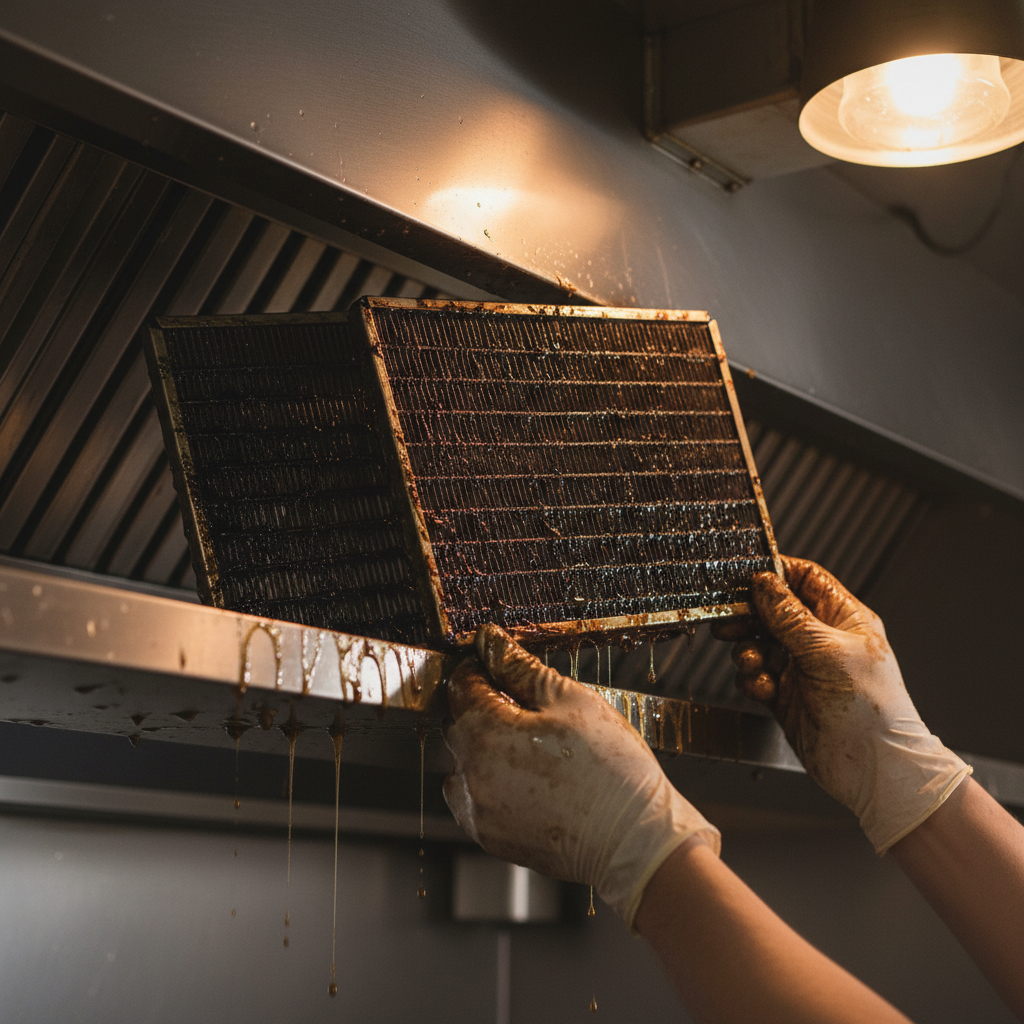
Immediate Replacement Triggers
- Warped or crushed frames that won’t seat flush in the track.
- Loose/missing rivets leaving open channels for flame and vapor.
- Broken/perforated baffles from improper cleaning or impact.
- Severe saturation—filters remain greasy after proper degreasing and rinse.
- Wrong type/size (e.g., mesh where listed baffles are required; gaps along the opening).
Filter Types, Rotation Models, and Exchange Approaches
Design your program around your menu, hours, and volume—then standardize across sites for consistency.
Common Grease Filter Types
- Stainless steel baffle
- Durable, fire-rated; designed to arrest flame and direct grease to troughs.
- Best for high-heat, high-grease concepts: grill, fry, wok.
- Aluminum baffle
- Lighter and easier to handle but more prone to deformation.
- Use gentle chemistry—harsh caustics can pit aluminum.
- High-efficiency baffle
- Increased capture for smoky operations; verify listing and airflow impact.
- Often needs tighter rotation to maintain stable pressure drop.
- Disposable pads/mesh (supplemental)
- Not a substitute for listed baffles where NFPA 96 requires them.
- May serve as pre-filters in limited cases—confirm with your provider.
Rotation and Exchange Models
- 1:1 on-site swap – Keep a full clean set; swap by schedule; degrease the used set later.
- Vendor exchange – Robinhood Cleaners delivers a clean set and removes the dirty set for off-site degreasing and inspection.
- Hybrid – Daily swaps on heavy lines; weekly on lighter lines.
- Deep-clean cadence – Sync filter deep-clean with hood/duct service for a full reset.
Quick Comparison: Replace vs. Clean vs. Rotate
| Action | Best For | Triggers | Notes |
|---|---|---|---|
| Replace | Damaged, wrong type/size, beyond recovery | Warping, broken baffles, loose rivets | Immediate; photo-document for audits |
| Clean | Intact baffles with heavy grease | Saturation without structural issues | Use proper degreasers; fully dry |
| Rotate | High-volume, long service hours | Menu load; smoke trends | Label racks; log swaps |
Best Practices and Common Mistakes
Our certified technicians see consistent patterns across Ontario kitchens. Build these habits—and avoid the pitfalls.
Best Practices
- Run a 60-second visual on each baffle at shift change: warping, blocked channels, pooled grease.
- Wipe hood tracks before inserting a clean filter to ensure a snug seat and better capture.
- Label sets by station (Grill, Fry, Wok) to maintain consistent performance.
- Train orientation: upside-down baffles can dump grease and compromise capture.
- Keep an absorbent-lined tray under the hood during swaps to reduce slip hazards.
- Sync filter deep-cleans with hood/duct service for a whole-system reset.
- Photo-document damaged filters and remove them from rotation immediately.
Common Mistakes
- Using mesh where baffles are required: Violates NFPA 96 in many hood types and increases fire risk.
- Mismatched sizes/gaps: Any gap defeats grease capture; standardize SKUs across sites.
- Over-aggressive chemicals on aluminum: Causes pitting and early failure.
- Swapping while the hood is hot and running: Increases burn risk and spreads aerosolized grease.
- Skipping documentation: Missing logs make inspections harder and trends invisible.
Need a same-night exchange or a full hood-to-rooftop reset? Robinhood Cleaners is NFPA 96 certified, WSIB insured, and available 24/7 across Ontario with quick Southern Ontario response. We handle Filter Cleaning & Exchange, Hood/Duct Cleaning, Exhaust Fan service, Fan Belt replacement, and Grease Trap cleaning—so you’re not juggling multiple vendors.
- Build a rotation plan for your menu and hours.
- Bundle rooftop fan inspection and belt checks with your next service.
- Ask for our printable exchange checklist for BOH training.
Local Tips
- Tip 1: If your kitchen is near Queen Street or Highway 410, schedule exchanges right after lunch or late night to avoid delivery traffic and staff overlap.
- Tip 2: Winter makeup air runs colder in Brampton—tighten rotation during heavy fry periods to maintain capture and reduce smoke roll-out.
- Tip 3: In plaza rooftops with shared access, use our WSIB-insured team for fan inspections and grease containment—tight spaces demand strict safety protocols.
IMPORTANT: These tips reflect Robinhood Cleaners’ 24/7 availability and fast Southern Ontario response for Brampton kitchens.
Tools, Supplies, and Resources
Equip your crew for speed, safety, and consistency.
- PPE: cut-resistant gloves, sleeves, safety glasses, non-slip footwear.
- Staging: absorbent pads, drip trays, labeled Clean/Dirty racks, slip-resistant mats.
- Cleaning: food-safe degreaser, soft-bristle brushes, low-pressure rinse, drying rack.
- Docs: laminated SOP at the hood, maintenance log binder, QR to a photo app for quick damage pics.
- Vendor support: an NFPA 96–certified partner who coordinates Filter Exchange with Hood/Duct, Exhaust Fan, Fan Belt, and Grease Trap service.
Optional Enhancements
- Barcode or color tags on filter sets to track rotation by station and week.
- Digital logs shared across sites for corporate oversight and simple audits.
- Grease containment kits on the roof to reduce staining and slip hazards.
How Often Should Brampton Kitchens Replace Filters?
Start with these ranges, then adjust using live line feedback and rooftop checks.
- Heavy grease (fried chicken, wings, burgers, woks): swap daily; deep-clean 1–2x per week; replace damaged units immediately.
- Moderate grease (grills, sauté, mixed menus): swap every 1–3 days; deep-clean weekly.
- Light operations (bakeries, cafés): swap weekly; deep-clean every 2–4 weeks.
- Catering/event spikes: add extra swaps around peak days and weekends.
Signals You Need Faster Rotation
- Smoke escaping at hood edges or chef’s eye level.
- Persistent grease odor in FOH or back corridors.
- Line feels hotter despite normal hood operation.
- Fan belt squeal, glazing, or vibration after busy service.
Documentation, Compliance, and Inspection Readiness
Good records turn inspections into routine checkpoints instead of emergencies.
- Filter log: date/time of swaps, station, staff initials, and damage notes.
- Photo evidence: snapshots of warped/broken units; store for audit trails.
- Service records: keep hood/duct certificates, rooftop fan reports, and exchange logs together.
- Listing and sizing: confirm filters are listed for grease applications and sized with no gaps along the opening.
For system alignment and smoother inspections, pair exchanges with the practices in our Ontario-wide overview of commercial hood cleaning.
SOPs and Staff Training Playbook
Train once, repeat everywhere. Here’s a compact, repeatable playbook for BOH teams.
- Five-minute huddle: review PPE, drip tray setup, and filter orientation before swaps.
- One-minute inspection: each baffle checked for warping, gaps, or pooled grease.
- Two-person swap: one tech handles removal and staging; the other cleans tracks and installs.
- Sign-off: log entries with initials; photo any damage and remove from service.
- Weekly refresh: short recap on common mistakes (orientation, gaps, hot swaps).
- Quarterly drill: dry-run a full hood-to-fan reset with your certified vendor.
Troubleshooting and Diagnostics
Symptoms on the line usually point to a short list of root causes. Use this to triage fast.
- Smoke roll-out at hood edges
- Likely: clogged filters, incorrect orientation, or undersized baffles.
- Action: swap in a clean set; verify seating; check for make-up air issues.
- Grease odor in FOH
- Likely: saturated filters and duct film buildup.
- Action: exchange filters now; schedule hood/duct deep-clean.
- Belt squeal or vibration
- Likely: high static pressure from clogged filters; belt glazing or mis-tension.
- Action: rotate filters; inspect and replace belts as needed; verify fan balance.
- Hot line despite normal settings
- Likely: reduced capture due to saturation or gaps.
- Action: re-seat with clean, correctly sized baffles; confirm make-up air.
- Grease streaking down hood
- Likely: upside-down orientation or damaged frames.
- Action: retrain orientation; remove damaged units from service.
Integrate Exchange with Systemwide Care
Filters are the front line. A resilient plan connects the path from cookline to rooftop.
- Hood & duct cleaning: remove grease that bypassed filters; reduce internal fire load.
- Exhaust fan service: clean blades, check bearings, verify vibration and balance.
- Fan belt replacement: check tension and glazing; replace if worn to prevent slippage.
- Grease trap service: avoid backups that derail service and attract pests.
- Power washing: pads, dumpsters, docks; reduce slip hazards and odors.
For multi-site operations, align exchanges with a quarterly hood/duct cycle as outlined in our Ontario-focused hood cleaning framework and region-specific GTA exhaust cleaning guidance.
Brampton Planning Scenarios
- Late-night operations along Queen Street: Schedule exchange right after last seating. Our 24/7 crews work around your hours to protect guest experience.
- Mall food courts and plazas: Coordinate access with property management; our WSIB-insured team navigates shared rooftops and tight access safely.
- Hotels and banquet centers: Scale rotation around event calendars; pair grease trap service before high-volume weekends.
- Multi-unit groups across Southern Ontario: One SOP, one vendor, consolidated reports—less admin, more uptime.
- Catering-heavy weekends: Add pre-event swaps and a Sunday night exchange window to reset before Monday prep.
Case Snapshots and Examples
Brief, anonymized snapshots from Ontario kitchens show how small changes deliver big results.
- High-volume fryer concept, Brampton
- Problem: Nightly saturation; smoke roll-out during dinner; recurring fan belt squeal.
- Action: Daily 1:1 swaps; deep-clean synced with hood/duct service; quarterly rooftop belt checks.
- Result: Restored capture, eliminated nuisance smoke, extended belt life.
- Hotel kitchen, Southern Ontario
- Problem: Mixed filter sizes causing gaps and inspection citations.
- Action: Standardized baffle types and sizes; labeled racks by line; moved to vendor exchange.
- Result: Clean inspection, smoother shift changes, faster close procedures.
- Multi-unit group across the GTA
- Problem: Inconsistent quality and documentation across sites.
- Action: Unified rotation cadence; shared checklists; photo logging; bundled Grease Trap and Fan Belt checks.
- Result: Predictable inspections, fewer emergencies, reduced vendor management.
- New concept launch, Brampton
- Problem: Unknown grease load with mixed grill/fry menu.
- Action: Started with daily swaps; tuned per station to every 1–2 days after two weeks of logs.
- Result: Stable capture, cooler line, and no inspection surprises at 90 days.
- Catering-heavy operation, Peel Region
- Problem: Weekend surges overwhelmed normal rotation; Monday smelled like Friday night.
- Action: Added pre-event swaps and Sunday night exchange with our 24/7 crew.
- Result: No more Monday smoke complaints; longer belt life.
- Plaza unit with tight rooftop access
- Problem: Delayed fan inspections due to safety concerns.
- Action: Scheduled WSIB-insured rooftop checks with fall protection and property coordination.
- Result: Cleared overdue issues; improved airflow and inspection readiness.
- Chain with mixed filter inventory
- Problem: Mismatch created gaps and under-capture.
- Action: Standardized SKUs and labeled racks by station.
- Result: Fewer smoke incidents and faster swaps.
- Wok-heavy kitchen, GTA
- Problem: Rapid saturation from high-heat stir-fry.
- Action: High-efficiency baffles with daily swaps and weekly deep-clean.
- Result: Improved capture, happier line cooks, cleaner ceilings.
- Bistro with mixed menu
- Problem: Inconsistent smoke during brunch rush.
- Action: Rotated by station load; added quick mid-shift swap on grill days.
- Result: Stable capture; fewer guest complaints.
- Food court stall
- Problem: Limited storage for clean sets.
- Action: Vendor exchange model with small on-site buffer.
- Result: Reliable swaps without sacrificing space.
- Bakery café
- Problem: Underestimating grease from breakfast sandwiches.
- Action: Increased swap frequency and added pre-filters (verified for listing).
- Result: Cleaner hood and less morning smoke.
- Pub with wing nights
- Problem: Friday surge overwhelmed normal rotation.
- Action: Pre-event swaps and Saturday dawn reset.
- Result: Steady capture through peak; easier cleanup.
- Campus kitchen
- Problem: Staffing turnover caused inconsistent orientation and gaps.
- Action: Laminated SOPs at the hood and biweekly micro-trainings.
- Result: Faster, safer swaps with fewer rework calls.
FAQ: Commercial Kitchen Exhaust Filter Replacement (Brampton)
- How do I know if my filters are the right size and type?
Filters should seat snugly with no gaps and be listed for grease applications per NFPA 96. If you’re unsure, our technicians can size and standardize your inventory during a service visit. - Can my team swap filters without interrupting service?
Yes. Many kitchens swap during prep or right after close. Stage a clean set, use PPE, follow the steps above, and log each exchange. We can also train your BOH team. - What’s the difference between cleaning and replacement?
Clean intact baffles that degrease fully. Replace when frames warp, rivets loosen, baffles break, or the wrong type/size is installed. - Why does my fan belt squeal after busy nights?
Clogged filters increase airflow resistance, overworking the fan and belt. Pair filter rotation with rooftop fan inspection and belt checks to prevent glazing and slippage. - Do you service outside regular hours?
Absolutely. Robinhood Cleaners operates 24/7 across Ontario with quick Southern Ontario response—ideal for after-hours work in Brampton.
Key Takeaways + Next Steps
- Filters are the hood system’s firewall—keep them intact, clean, and correctly sized.
- Let menu and hours drive your swap cadence; increase rotation at the first sign of smoke or heat creep.
- Document exchanges, standardize inventory, and align filter work with hood/duct and rooftop fan care.
- Lean on NFPA 96–certified help when you need speed, safety, and audit-ready documentation.
Ready to lock in a rotation that fits your line? Book a filter exchange and hood-to-fan assessment with Robinhood Cleaners—serving All Over Ontario with fast Southern Ontario response.
Related Topics to Explore
- How filter rotation extends rooftop fan and belt life
- Designing a multi-site exchange SOP that scales
- Coordinating hood/duct service around seasonal peaks
- Grease trap scheduling to prevent weekend backups