Kitchen hood maintenance is the routine inspection, cleaning, and servicing of commercial hood systems to prevent grease buildup, airflow restrictions, and fire risks. For restaurants across All Over Ontario, consistent hood care keeps teams safe, protects equipment, and supports compliance. Robinhood Cleaners provides certified service aligned with kitchen schedules to make it practical, reliable, and thorough.
By Robinhood Cleaners • Last updated: 2026-05-14
Summary
Kitchen hood maintenance reduces grease, improves airflow, and lowers fire risk. Clean baffles weekly, inspect belts monthly, and schedule professional exhaust cleaning on a recurring cadence based on cooking volume. Document each service to support insurance and fire code compliance, and train staff to spot hazards between services.
This complete guide is built for restaurant operators and commercial kitchen managers in All Over Ontario who want a clear, practical plan. You’ll find:
- Actionable routines for daily, weekly, and monthly kitchen hood maintenance
- When to DIY (filters) vs. when to call pros (ducts, fans, full exhaust)
- Compliance-aligned schedules that fit high-, medium-, and low-volume kitchens
- Checklists, a frequency table, and safety tips tied to cleaning hazards
- Examples from Robinhood Cleaners’ day-to-day work across Ontario
What is kitchen hood maintenance?
Kitchen hood maintenance is the planned cleaning and inspection of hoods, baffle filters, ducts, and exhaust fans to remove grease and ensure safe airflow. It includes routine staff tasks and scheduled professional service to keep systems compliant, efficient, and fire-safe.
In practice, kitchen hood maintenance blends staff routines with professional exhaust cleaning. Staff tackle visible surfaces and filters; certified crews degrease the hood plenum, ductwork, and rooftop fan. Together, they protect people, equipment, and uptime.
Core components you’re maintaining
- Hood canopy and plenum: Captures fumes and grease; needs degreasing and inspection.
- Baffle filters: First line of defense. Clean and rotate regularly; replace when bent or worn.
- Exhaust ducts: Move vapors out. Professional degreasing removes hidden combustible layers.
- Exhaust fan (upblast/sidewall): Drives airflow; belts, bearings, and hinges need checks.
- Make-up air unit: Balances pressure; clogged filters or faulty sensors disrupt capture.
We tie these elements together with photos, service reports, and a maintenance log so your team can track performance and spot trends over time.
Why kitchen hood maintenance matters
Regular hood care cuts fire risk, keeps airflow strong, and supports code compliance. It also improves kitchen comfort, reduces odors, and protects equipment, which helps avoid downtime during peak periods and keeps service moving.
Grease accumulates fast under heat. Even a thin film is combustible, and deeper layers in ducts can ignite from flare-ups. Consistent kitchen hood maintenance lowers this risk while improving capture efficiency—meaning less smoke and fewer alarms during rushes.
- Fire risk reduction: Removing grease deposits lowers ignition sources in hoods and ducts.
- Airflow and comfort: Strong exhaust equals less smoke and heat; staff fatigue drops.
- Compliance support: Documented service aligns with fire code expectations and insurance.
- Equipment longevity: Clean systems reduce strain on motors, belts, and bearings.
- Operational reliability: Less surprise downtime; smoother audits and inspections.
In our experience servicing quick-service and fine-dining kitchens, teams that keep a clear schedule see fewer emergency calls and steadier performance during long shifts.
Local considerations for All Over Ontario
- Plan major degreasing during slower dayparts to minimize disruption; many kitchens in the region run long hours.
- Seasonal humidity impacts capture efficiency; verify fan belts and filters before summer heat ramps up.
- Document every service for local fire inspections and insurance reviews; keep logs accessible to managers.
How a commercial hood works
A commercial hood captures heat and grease-laden vapors at the source, pulls them through baffle filters, and moves them via ducts to a rooftop fan that expels air outside. Make-up air replaces exhausted air to keep kitchen pressure stable and capture effective.
When capture and containment are tuned, the hood lip pulls smoke inward, filters trap grease, ducts carry vapors away, and the fan expels them. If any step fails—bent filters, slipping belts, clogged ducts—you’ll feel heat, see haze, and notice lingering odors.
Common failure points we find
- Filters installed backward or missing panels: Reduces grease capture and raises fire risk.
- Fan belt glazing or slack: Causes poor draw; kitchens notice smoke spill and hotter lines.
- Blocked duct transitions/elbows: Grease thickens at turns; requires pro-grade degreasing.
- Hinge kit missing on rooftop fan: Makes service unsafe and leads to damaged wiring or roofs.
- Make-up air imbalance: Doors whistle, pilot lights struggle, and capture plumes escape.
Types of hood maintenance (staff vs. professional)
Handle daily wipe-downs and weekly filter cleaning in-house. Schedule certified professionals for full hood, plenum, duct, and exhaust fan degreasing on a recurring cadence. This split keeps costs predictable and compliance on track.
We organize kitchen hood maintenance into two roles so teams know exactly who handles what and when.
Staff-led routines
- Daily: Wipe hood exterior and undersides; empty grease cups/trays; verify lights and switches.
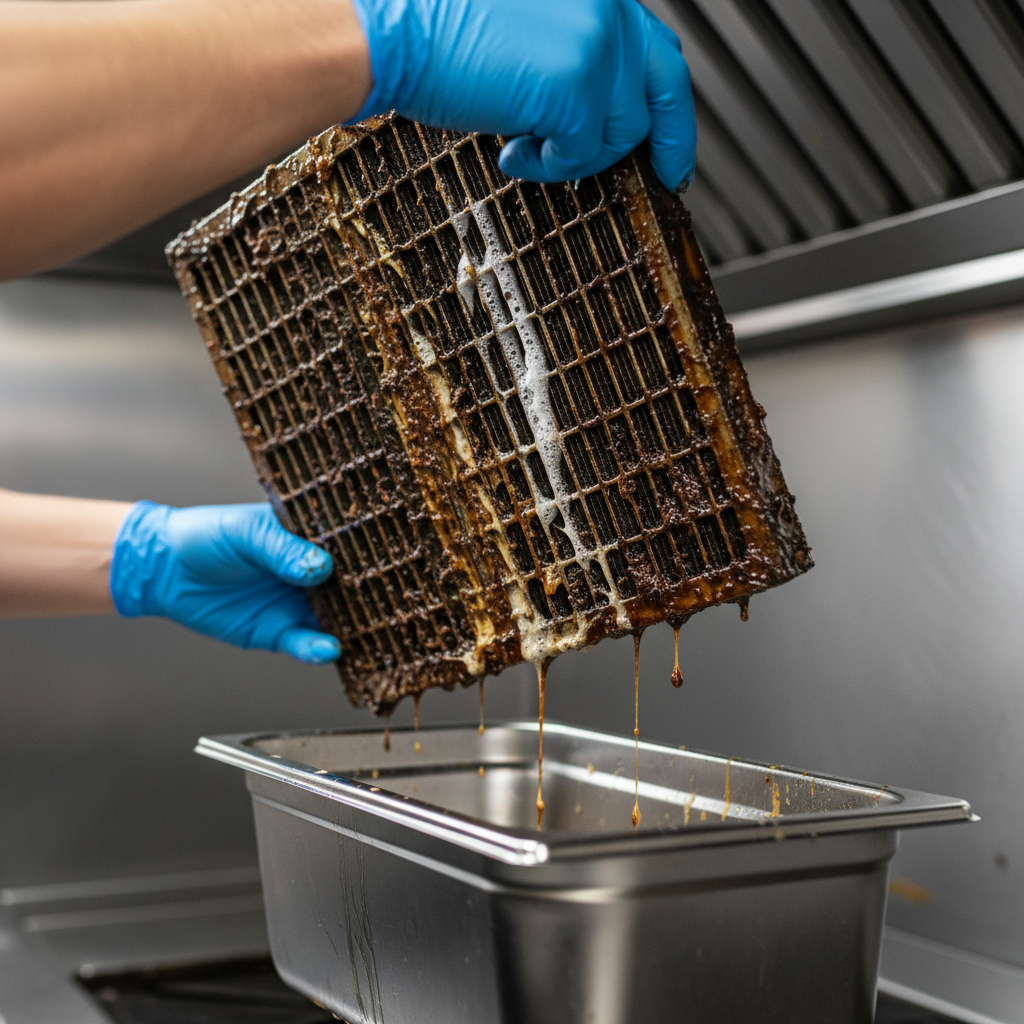
- Weekly: Remove and soak baffle filters; rotate clean sets; inspect for dents or warping.
- Monthly: Check capture performance, note unusual noise or vibration, and log issues.
Professional service (Robinhood Cleaners)
- Full exhaust system degreasing: Hood, plenum, accessible ducts, and exhaust fan housing.
- Exhaust fan maintenance: Belt inspection/replacement, motor check, hinge kit and duct access.
- Documentation: Post-service photos, service stickers, and maintenance logs for audits.
- Complementary services: kitchen exhaust cleaning, exhaust fan maintenance, and exhaust duct cleaning benefits that reduce cleaning hazards.
Many Ontario kitchens run 12–16 hours daily. Splitting duties this way keeps capture strong between deep cleans and helps managers plan labor effectively.
Maintenance frequency by kitchen volume
Match frequency to cooking volume. High-volume fry and grill lines need professional exhaust cleaning more often than light-duty kitchens. Rotate clean filters weekly, inspect belts monthly, and set a recurring exhaust service based on real usage patterns.
| Kitchen volume | Typical equipment | Staff tasks | Pro service cadence |
|---|---|---|---|
| High (QSR, fryers, grills) | Multiple fryers, char grills | Daily wipe-downs; weekly filter exchange | Every 1–3 months |
| Medium (casual dining) | Mixed line, saute, oven | Daily wipes; weekly filter clean | Every 3–4 months |
| Light (schools, low-grease) | Combi/ovens, minimal fry | Weekly filter rotation | Every 6 months |
Use actual soil load to fine-tune. If filters drip quickly or staff see smoke spill, tighten the schedule. Robinhood Cleaners documents grease levels so managers can adjust with confidence.
Step-by-step filter care (staff)
Remove baffle filters when cool, soak in degreaser, rinse hot, dry fully, and reinstall with baffles oriented correctly. Keep a second clean set on-hand to swap quickly during busy weeks without disrupting service.
- Cool the line: Avoid burns and protect aluminum or stainless surfaces.
- Remove baffles safely: Wear gloves; tilt to drain grease to a tray, not the floor.
- Soak in degreaser: Use a designated basin; scrape heavy soil first.
- Rinse hot and dry: Prevents streaks and bacterial growth.
- Reinstall correctly: Arrows upward; verify no gaps between filters.
- Log the cycle: Date, staff initials, any damage noted.
Need help choosing filters? See our kitchen hood filter types comparison and our filter replacement schedule guidance.
Professional exhaust cleaning: what to expect
Certified technicians degrease the hood, plenum, ducts, and exhaust fan; inspect belts and bearings; and document work with photos and a service sticker. Expect containment, floor protection, and overnight or off-peak scheduling to avoid downtime.
Our teams stage plastic containment and floor protection, remove and label filters, and apply heated degreaser to the hood and plenum. We access ducts via panels, clean to bare metal where reachable, and service the rooftop fan using a hinge kit to protect wiring and roof surfaces.
- Safety first: Lockout/tagout for fan motors; fall protection on roofs.
- Fan service: Belt check and fan belt replacement when needed; verify amp draw and vibration.
- Verification: Before/after photos; sticker with date and next target service window.
- Complementary cleaning: We can align with hood cleaning and exhaust cleaning the same night.
Want a refresher on requirements and best practices? Review our Ontario-focused overview of fire code requirements for kitchen exhaust.
Cleaning hazards to watch—and how to prevent them
Main hazards include grease ignition, chemical exposure, slips and falls, and roof damage during fan service. Control them with proper PPE, lockout/tagout, trained technicians, hinge kits, and documented procedures that align with cleaning hazards best practices.
- Grease ignition risk: Avoid open flames during cleaning; verify pilots are off and cooled.
- Chemical handling: Use labeled containers and eye/hand protection; never mix products.
- Slip/fall prevention: Contain runoff; use non-slip mats; keep walkways dry.
- Rooftop protection: Use hinge kits and lift fans correctly to prevent duct or roof damage.
- Documentation: Log SDS, PPE, and training records to support audits.
We bake these controls into every visit so your team stays productive while we handle the heavy lifting.
Tools and supplies for effective hood care
Successful maintenance needs the right tools: spare baffle filters, food-safe degreasers, non-scratch pads, wet/dry vacs, and rooftop hinge kits. Professionals add heated pressure systems, duct access tools, and safety gear for confined and elevated work.
For your staff
- Spare sets of baffle filters sized to your hood
- Food-safe degreaser and non-scratch pads
- Grease-resistant gloves and face shields for splash protection
- Labeled basins for soaking and rinse
- Maintenance log binder or digital checklist
What our technicians bring
- Heated pressure washing systems and foam cannons
- Duct access tools, scrapers, and drill-driven brushes
- Rooftop hinge kits and grease containment
- Lockout/tagout kits and fall protection
- Photo documentation and service stickers
If you prefer a full-service approach, see our Ontario-wide commercial hood cleaning service overview.
Case examples from All Over Ontario
Real kitchens see measurable gains: stronger capture, cooler cooklines, and fewer alarms after consistent service. By pairing weekly filter swaps with quarterly exhaust cleaning, teams stabilize performance through long shifts and inspections.
- Quick-service grill line: Heavy fry and char smoke triggered alarms. After belt replacement and duct degreasing, draw improved and haze dropped visibly during lunch rush.
- Hotel banquet kitchen: Seasonal volume swings strained capture. We set a variable schedule and added a hinge kit; rooftop service time shortened and roof stains ceased.
- Institutional kitchen: Staff rotated filters weekly but saw drip lines. We swapped bent baffles, logged changes, and aligned deep cleans with school breaks to avoid downtime.
These are typical outcomes when kitchen hood maintenance is planned and measured rather than reactive.
Scheduling and checklists you can use today
Build a simple plan: daily wipes, weekly filter swaps, monthly belt checks, and recurring professional exhaust cleaning. Track everything in one log so inspections are faster and trends are easy to spot.
Your at-a-glance checklist
- Daily: Wipe hood undersides and edges; empty grease cups.
- Weekly: Clean or exchange baffle filters; inspect for gaps.
- Monthly: Check fan belt tension and listen for vibration.
- Quarterly/Semiannual: Book professional hood, duct, and fan service.
- Always: Update the maintenance log with dates and notes.
Want more depth on filter routines? See our grease filter cleaning guide for step-by-step visuals and pro tips.
Service credentials and coverage
Robinhood Cleaners fields NFPA96-aware, WSIB-insured crews with 24/7 scheduling across Ontario. We align with kitchen hours, provide documented results, and offer a full range of exhaust, duct, hood, and appliance cleaning services.
- Credentials: WSIB insured; teams trained on NFPA96-aligned procedures and fire-safe methods.
- Availability: Off-peak, overnight, and 24/7 options to fit service windows.
- Coverage: Quick service in Southern Ontario with reach across All Over Ontario.
- Range: Exhaust, hood, duct, kitchen exhaust cleaning, and allied services.
If you need a primer on Ontario-focused hood cleaning expectations, review this overview of hood cleaning services in Ontario.
Free maintenance assessment: Want a second set of eyes on your hood system? We’ll review your current schedule, photos, and staff routines, then recommend a safety-first plan that fits your hours.
Frequently Asked Questions
Operators ask about frequency, DIY limits, inspection prep, and warning signs. Clean filters weekly, schedule professional exhaust cleaning on a usage-based cadence, document everything, and call a pro if you notice smoke spill, belt squeal, or grease drips.
How often should a commercial hood be professionally cleaned?
Base cadence on cooking volume: high-volume fry and grill lines every 1–3 months, moderate volume every 3–4 months, and low-grease kitchens about every 6 months. Track grease levels and adjust if filters drip quickly or smoke escapes the hood.
What parts can our staff safely clean?
Staff can wipe external hood surfaces daily and clean or exchange baffle filters weekly. Leave plenum interiors, ducts, and exhaust fans to trained professionals who have the right tools, access panels, fall protection, and containment methods.
What are early warning signs that our system needs service now?
Watch for visible haze at the hood lip, persistent cooking odors, belt squeal, rattling at startup, or grease drips from seams. Any of these suggest airflow loss or grease buildup—schedule professional service before peak hours.
How should we prepare for an overnight cleaning?
Clear counters and shelves near the hood, power down cooking equipment, and ensure rooftop access. We’ll protect floors and equipment, set containment, and coordinate with a manager to review photos and next steps before reopening.
Key takeaways and next steps
Keep kitchen hood maintenance simple: clean filters weekly, check belts monthly, and book recurring exhaust service by volume. Log results, train staff to spot hazards, and align service windows with your slowest hours for minimal disruption.
- Start a single maintenance log for everything hood-related.
- Set calendar reminders for filter swaps and inspections.
- Use a usage-based cadence for professional exhaust cleaning.
- Align service with overnight or off-peak windows.
- When in doubt, schedule a safety check—small fixes prevent big problems.
Ready to stabilize capture and reduce cleaning hazards? Explore our Ontario-wide exhaust cleaning services or review our hood cleaning guide for deeper technical details.