Grease filter cleaning is the scheduled removal of grease and debris from commercial hood baffle filters to restore airflow and reduce fire risk. In All Over Ontario, restaurants rely on Robinhood Cleaners’ Filter Cleaning & Exchange to keep systems safe, NFPA 96–aligned, and inspection-ready without disrupting service.
By Robinhood Cleaners • Last updated: May 13, 2026
Overview
This complete guide explains what grease filter cleaning is, why it matters for fire safety and compliance, and exactly how to do it. You’ll get step-by-step instructions, prerequisites, methods to choose from, troubleshooting tips, and real Ontario examples—plus links to related exhaust, hood, and duct services.
Here’s what you’ll learn in a few minutes:
- What baffle filters do, and how neglected filters raise fire risk
- How to plan and perform a thorough, safe cleaning (11 clear steps)
- When to swap filters using a professional Filter Cleaning & Exchange
- How cleaning frequency ties to NFPA 96 and inspection records
- Quick fixes for odors, smoke, poor draw, and repeat grease
Table of contents
- What is grease filter cleaning?
- Why grease filter cleaning matters
- How filters and cleaning work
- Prerequisites: tools, PPE, safety checks
- Step-by-step cleaning procedure (11 steps)
- Methods to choose (soak, steam, ultrasonic, exchange)
- Best practices and NFPA 96 alignment
- Troubleshooting common issues
- Tools, resources, and checklists
- Ontario case examples
- Frequently asked questions
What is grease filter cleaning?
Grease filter cleaning is the planned removal of grease from hood baffle filters to keep exhaust airflow strong and reduce fire hazards. In practice, it means disassembling filters, degreasing them fully, inspecting for damage, and reinstalling or exchanging them on a defined schedule with documented results.
In a commercial kitchen, baffle filters capture airborne grease before it travels into ducts and the exhaust fan. When filters clog, draw drops, smoke lingers, and fire risk rises. A disciplined program—often monthly to quarterly depending on volume—keeps buildup in check and operations compliant.
- Core function: Stop grease aerosols from reaching ducts and fans.
- Immediate benefit: Better airflow and smoke capture after a single thorough clean.
- Programmatic value: Cleaner ducts and hoods, fewer emergency callouts, smoother inspections.
For teams that prefer zero-downtime swaps, our Filter Cleaning & Exchange rotates pre-cleaned filters in minutes and removes the dirty set for off-site processing and documentation.
Why grease filter cleaning matters
Clean filters lower fire risk, keep airflow strong, and support NFPA 96–aligned operations. When filters load with grease, capture efficiency drops, smoke and heat spread, and inspections get harder to pass—especially during busy seasons in Ontario’s food service industry.
How filters and cleaning work
Baffle filters force a zigzag airflow that strips grease from hot vapors. Cleaning removes the captured film so air can turn sharply again without drag. Restored fins, clear drains, and tight fitment return the hood to designed capture velocity and reduce duct contamination.
Here’s the science in plain terms: when vapor hits the baffle’s turns, inertia separates grease droplets, which drain into the baffle’s channels. As films thicken, turn efficiency drops, and more grease bypasses into the hood plenum and ducts. That’s why film thickness and fin cleanliness directly impact performance.
- Visible cues: Rainbow sheen, sticky residue, and slow drainage in channels indicate performance loss.
- Measurable cues: Higher hood face temperatures and rising manometer readings suggest airflow restriction.
- Fitment matters: Gaps around frames cause bypass; proper sizing keeps capture efficient.
When cleaning is paired with periodic exhaust duct cleaning and routine hood cleaning, you build a layered defense that protects the entire system.
Prerequisites: tools, PPE, safety checks
Before you start, secure the cookline, power down ignition sources, and stage PPE and degreasers. Confirm filter type, note fire suppression nozzles, and protect work areas. Set up labeled racks for wet, rinsed, and dry filters to avoid mix-ups and speed reinstall.
Good prep cuts total downtime by 20–30 minutes in busy kitchens because techs aren’t hunting for gear mid-task. In our experience, a simple checklist posted inside the dish area eliminates many missteps.
Safety checks
- Lock out pilot lights and cover open flames; let surfaces cool to under 100°F.
- Verify nozzles for fire suppression aren’t obstructed; note their positions for reinstallation.
- Lay absorbent mats and place wet floor signs to prevent slips.
- Ventilate the area; crack back-of-house doors or run make-up air to limit chemical odors.
Tools and materials
- Food-service safe degreaser (alkaline, non-caustic), pH typically 10–12 when diluted.
- Nylon/soft bristle brushes, non-scratch pads, and a plastic scraper for heavy deposits.
- Spray bottles or foaming sprayers for controlled application.
- Large sink or soak tank; optional heated tank at 140–180°F for faster breakdown.
- Rinse hose with spray nozzle and a drying rack or blower for faster turnaround.
- PPE: gloves, eye protection, apron, and non-slip footwear.
If your operation can’t spare even a short interruption, our filter exchange program swaps in a clean set while we process the dirty filters off-site.
Step-by-step grease filter cleaning (11 steps)
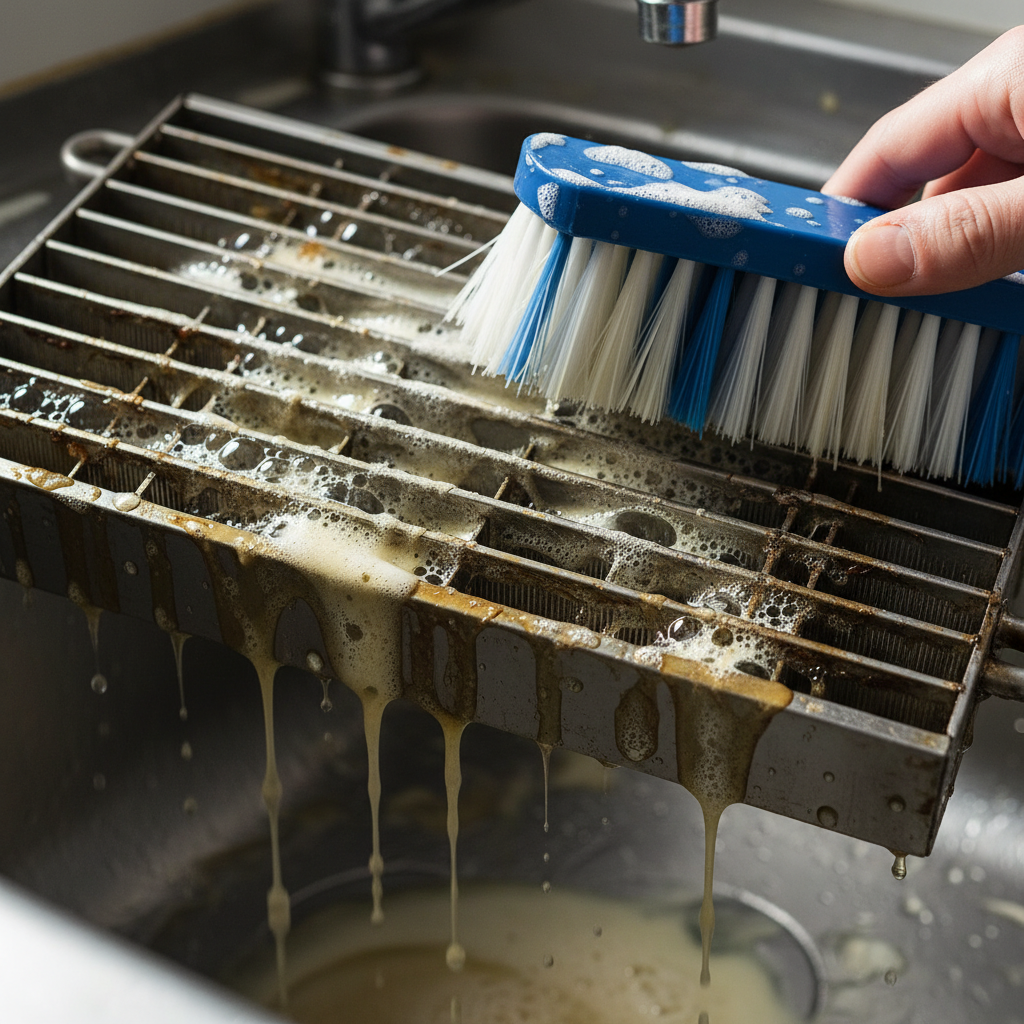
Use this 11-step process to clean baffle filters thoroughly: cool and power down, remove filters, pre-scrape, pre-rinse, apply degreaser, agitate, soak, rinse, neutralize, dry, and reinstall. Photograph each stage for documentation and verify airflow recovery at the hood.
- Cool and secure the line: Let metal cool below 100°F. Turn off burners and pilots.
- Remove filters carefully: Support the weight; note order and orientation for reassembly.
- Pre-scrape heavy deposits: Use a plastic scraper to lift 1–2 mm films that slow degreasing.
- Pre-rinse: Use warm water to knock off loose soil. Aim 2–3 minutes per filter side.
- Apply degreaser: Spray evenly. Allow 5–7 minutes of dwell for typical soils.
- Agitate: Brush along fin direction to protect edges and drainage paths.
- Soak: Submerge in 140–180°F solution for 20–45 minutes depending on soil load.
- Final rinse: Rinse until runoff runs clear; about 2–4 minutes per side.
- Neutralize (if needed): Brief dip in neutralizing rinse helps prevent residue and streaking.
- Dry: Stand filters vertically on racks; use airflow or a blower to speed drying.
- Reinstall and verify: Fit baffles snugly. Confirm capture using a visible smoke test.
Tip: Keep three zones—dirty, wash, and clean/dry—so you never cross-contaminate. Labeling racks “A/B/C” saves minutes on every rotation in high-volume kitchens.
Methods to choose (soak, steam, ultrasonic, exchange)
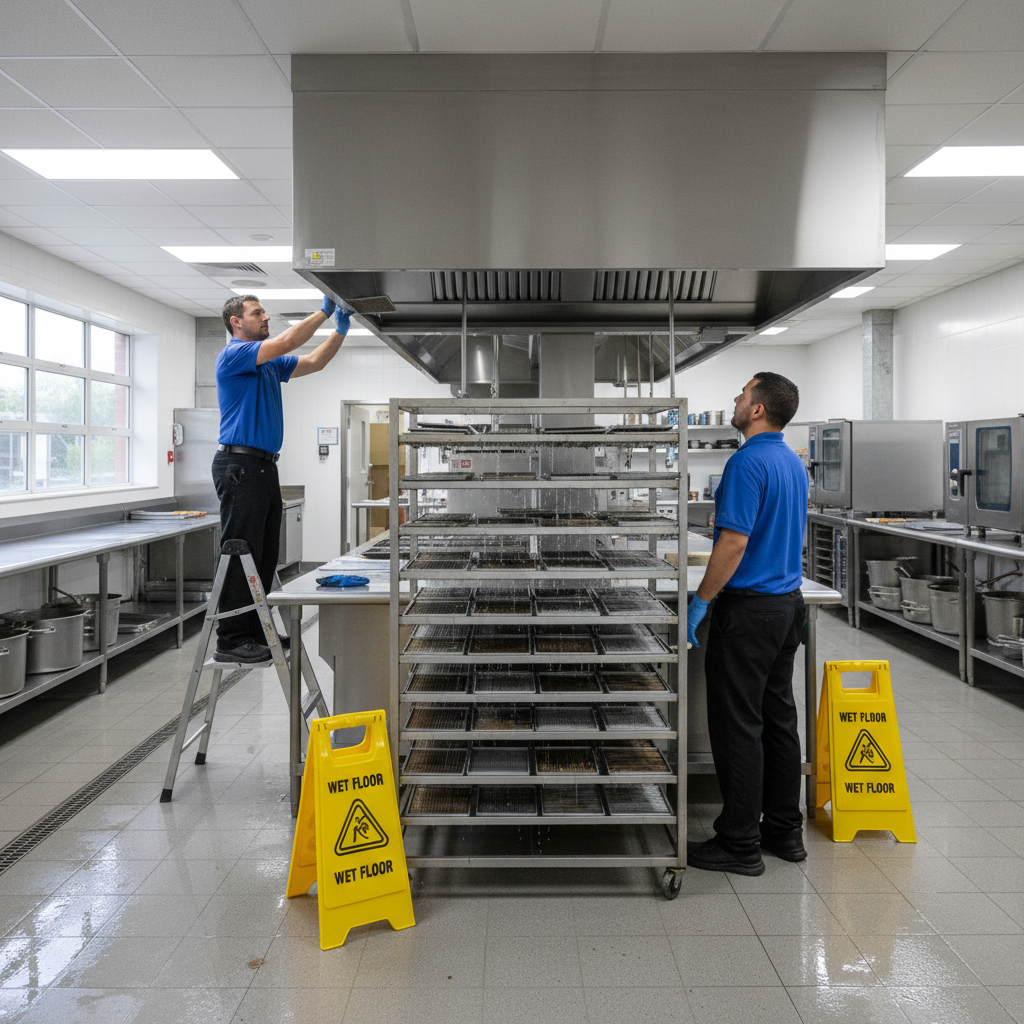
Choose the method that matches your soil load, downtime window, and labor. Soak tanks are dependable, steam accelerates tough jobs, ultrasonic excels on detail, and exchange programs keep the line running with zero on-site mess.
Common methods
- Soak tank cleaning: Heated, food-safe alkaline solution softens thick deposits. Reliable and scalable; plan 30–60 minutes dwell for heavy loads.
- Steam cleaning: High-temperature steam emulsifies grease without harsh agitation; useful near delicate finishes.
- Ultrasonic cleaning: Cavitation reaches into tight fin channels; ideal for fine debris and restoring like-new sheen.
- Filter Cleaning & Exchange: Swap in a pre-cleaned set, remove the dirty set for off-site processing and documentation.
Method comparison
| Method | Best for | Time on-site | Soil tolerance | Notes |
|---|---|---|---|---|
| Soak tank | Heavy buildup | Moderate | High | Consistent results with proper chemistry and heat |
| Steam | Grease + residue | Low–Moderate | Medium | Great near sensitive finishes; quick turnaround |
| Ultrasonic | Detail cleaning | Low (off-site) | Medium–High | Restores channels others miss |
| Exchange | No downtime | Very low | Any (processed off-site) | Best for 24/7 or peak-only windows |
If you’re weighing options, our team can align the method with your grease management plan and existing duct cleaning cycle.
Best practices and NFPA 96 alignment
Follow a documented schedule, keep photo records, and integrate filter cleaning with hood, duct, and fan service. Align frequency to cooking volume using NFPA 96 guidance, and verify capture with simple tests after each cleaning or exchange.
- Set frequency by volume: Many high-volume operations service monthly; moderate kitchens often go quarterly. Store logs where managers and inspectors can review quickly.
- Pair services: Combine with hood, duct, and grease trap service for a consistent, compliant system.
- Train and audit: Quick refreshers reduce rework. A 10-minute tailgate talk before the shift makes a difference.
- Measure capture: A smoke test or simple tissue test at the hood face confirms draw improvements immediately.
OSHA’s restaurant eTool highlights ventilation and hood performance as key factors in kitchen safety and comfort. kitchens.
Troubleshooting common issues
If smoke lingers, odors persist, or grease returns fast, check filter orientation, gaps, chemistry strength, and fan performance. Quick airflow checks and a flashlight inspection usually pinpoint the issue within minutes.
Airflow and fitment
- Smoke still escaping: Confirm filters face the correct direction; baffles should capture rising vapors toward the plenum.
- Bypass around frames: Look for gaps. Replace bent frames and ensure tight fitment to stop shortcuts.
- Weak draw at hood face: Inspect the roof fan and belt tension. Our fan-belt check is a fast win if the belt is glazed or loose.
Cleaning quality
- Grease reappears in days: Increase soak time to 45–60 minutes and verify degreaser dilution.
- Streaking on stainless: Rinse longer and use a neutralizing dip to stop alkaline residue.
- Odors after shutdown: Clean the hood plenum lips and drains; residual soil there can smell even with clean baffles.
Scheduling and documentation
- Missed cycles: Add calendar holds aligned to service windows (early morning or post-close).
- Inspection gaps: Keep a binder (or digital folder) with date-stamped photos and service logs.
Need a reset? A combined hood, filter, and duct service restores the baseline fast—then your regular rotation keeps it that way.
Tools, resources, and checklists
Standardize your process with a one-page checklist and labeled racks. Choose food-safe chemistry, protect finishes, and train staff on PPE and slips prevention. Keep spare filters on hand so a damaged baffle never sidelines a line.
- Quick checklist: Power down, remove filters, pre-scrape, pre-rinse, degrease, agitate, soak, rinse, neutralize, dry, reinstall, verify.
- Supplies to stock: Two brush sizes, non-scratch pads, plastic scraper, degreaser, neutralizer, absorbent mats, and tags for documentation.
- Exchange-ready inventory: Maintain at least one full spare set per hood size for instant swaps.
- Training aids: Post the 11-step list in the dish area; audit monthly.
For a deeper systems view, align filter care with broader NFPA 96 compliance steps and your kitchen’s ventilation maintenance calendar.
Ontario case examples
These brief Ontario scenarios show how the right method, schedule, and documentation solve real kitchen problems. Each example uses Robinhood Cleaners’ services that operate across All Over Ontario with 24/7 scheduling windows.
- Quick service grill line: Heavy soil returned within a week. We increased soak temperature to 170°F, extended dwell to 45 minutes, and added a weekly pre-rinse. Result: visible smoke reduced at the pass and steadier draw through lunch rush.
- Institutional kitchen: Limited downtime allowed only 30-minute windows. Our Filter Cleaning & Exchange kept service on-time; we processed the dirty set off-site and logged photos.
- Food court tenant: Odors after close traced to plenum lips. We included a plenum wipe-down with every filter cycle, cutting next-day odor complaints to near zero.
- Fine dining sauté line: Persistent haze flagged a loose roof-fan belt. A coordinated fan belt replacement and deep baffle clean restored capture immediately.
Across these operations, the common thread was simple: pair consistent grease filter cleaning with system-level checks, and document everything.
Local considerations for All Over Ontario
- Seasonal humidity swings can thicken grease films faster; during summer, consider moving from quarterly to every 6–8 weeks for high-volume lines.
- Holiday peaks compress maintenance windows. Use early morning exchanges to avoid disrupting service during December rushes.
- Many kitchens juggle shared exhaust in multi-tenant settings. Coordinate service windows with neighbors to prevent backdraft issues while filters are out.
Need a hand planning your schedule? Robinhood Cleaners is NFPA 96–certified, WSIB insured, and available 24/7 across All Over Ontario. We’ll align grease filter cleaning with your hood, duct, fan, and grease trap services for a safer, cleaner kitchen.
Frequently asked questions
These concise answers address how often to clean, what method to choose, how to spot damage, and when to exchange filters. Each response is inspection-minded and grounded in everyday kitchen realities.
How often should commercial baffle filters be cleaned?
Match frequency to cooking volume. High-volume lines often clean monthly; moderate kitchens trend quarterly. Align with the framework in NFPA 96 and keep photo logs so inspections go smoothly and schedules can be adjusted by season.
What’s the fastest method if we can’t afford downtime?
A Filter Cleaning & Exchange is the quickest: swap in a clean set, remove the dirty filters for off-site processing, and keep the line moving. It’s ideal for 24/7 operations or tight prep windows.
How do I know if a filter is damaged and needs replacing?
Look for bent frames, loose baffles, pinholes, or warped fins. If filters don’t seat tightly or show daylight at the frame edges, replacement is the safer choice to prevent bypass and restore capture.
Do clean filters really improve airflow that much?
Yes. Even a thin grease film adds drag that weakens capture at the hood face. After a proper clean, simple smoke or tissue tests show stronger draw and better containment during busy service.
Key takeaways
Grease filter cleaning protects your people, property, and productivity. Set a schedule, document the work, and link filter care to hood, duct, fan, and grease trap service. If uptime is critical, choose a Filter Cleaning & Exchange to keep cooking while we handle the mess.
- Clean baffles reduce fire risk and improve capture immediately.
- Photo logs and dates make inspections faster and less stressful.
- Method choice should match soil load, downtime, and finish care.
- System-level checks (ducts, fans, belts) keep gains durable.