Cleaning hazards are sources of harm created by cleaning chemicals, equipment, and processes that can cause injury, illness, fires, or downtime. In All Over Ontario, Robinhood Cleaners reduces cleaning hazards in commercial kitchens through NFPA 96–aligned hood and duct service, safe chemical handling, and documented SOPs that keep staff protected and inspections smooth.
By Robinhood Cleaners • Last updated: 2026-05-01
At a Glance: What this guide covers
Use this guide to identify cleaning hazards in commercial kitchens and apply proven controls without slowing service. You’ll get definitions, root causes, step-by-step controls, checklists, and documentation tips aligned to NFPA 96 so your team can work safer, pass inspections, and keep the line moving.
This complete guide is built for restaurants, institutional kitchens, hotels, and food courts that operate year-round. It explains what cleaning hazards are, why they matter to your crew and guests, how control measures work, and how Robinhood Cleaners puts them into practice across Southern Ontario.
- Clear definition and real-world examples of cleaning hazards
- Why hazards escalate in hot, greasy, high-volume lines
- How control measures reduce fire, injury, and downtime
- Field-tested best practices, tools, and PPE that actually help
- Case snapshots from Ontario kitchens to show results
Local considerations for All Over Ontario
- Plan rooftop fan service around fast-changing weather; spring and fall winds increase fall risk and require extra anchor checks.
- Holiday rushes and summer festivals extend fry hours; tighten hood, duct, and filter exchange cycles during these periods.
- Coordinate overnight power washing and degreasing to avoid morning deliveries; stage drying zones to prevent early-shift slips.
What are cleaning hazards?
Cleaning hazards are identifiable sources of harm during cleaning tasks—chemical exposure, slips, fire from grease, electrical shock, heat/steam burns, biological contact, and fall risks. In commercial kitchens, they concentrate around hoods, ducts, exhaust fans, floors, drains, and chemical storage.
In our work, we see hazards spike where heat, moisture, and grease intersect. Examples include aerosolized degreasers used near open flames, slippery floors after power washing, or rooftop fan service without fall protection. Recognizing these patterns early lets you design controls that prevent incidents and unplanned shutdowns.
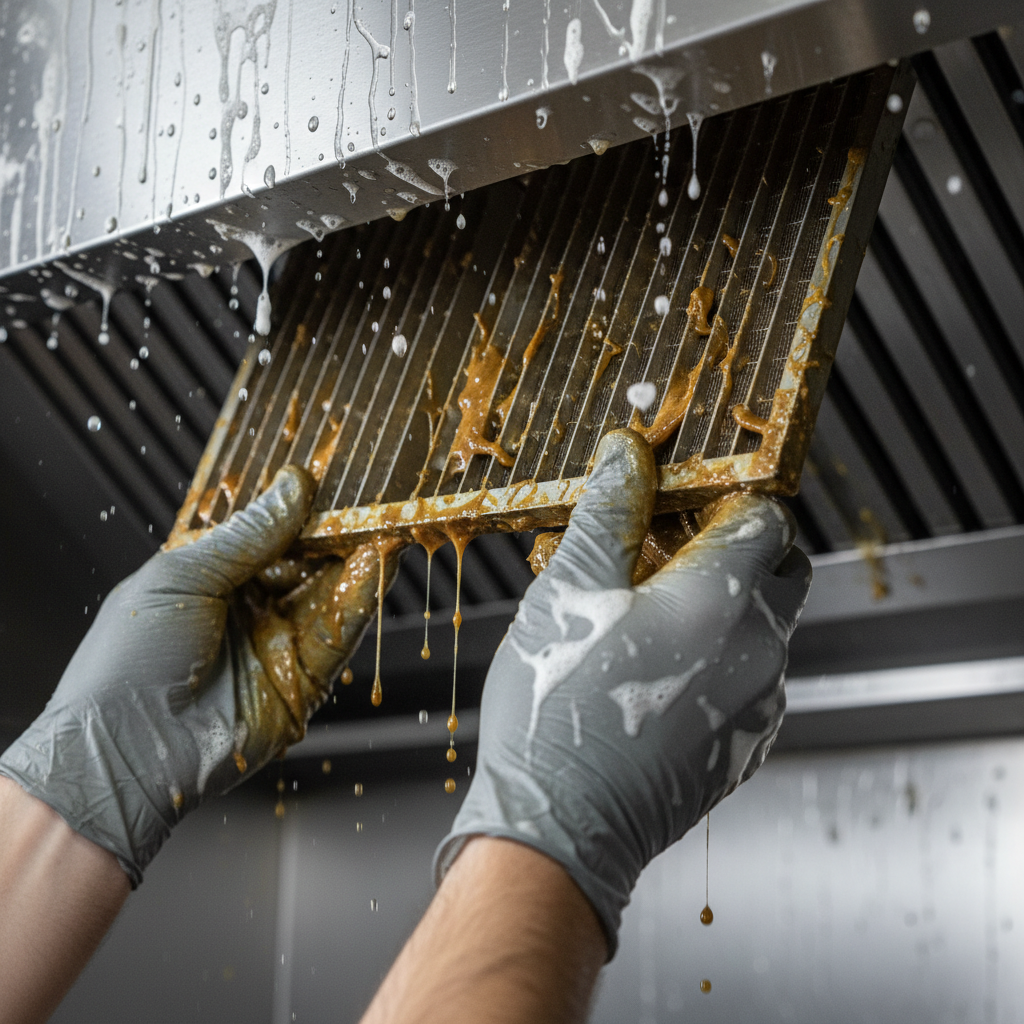
Kitchen exhaust systems are a common hotspot. Grease collects in baffle filters, horizontal ducts, elbows, and fan housings. If not removed on a set cadence, capture efficiency drops and ignition risk rises. That is why our teams pair deep hood and duct cleaning with filter exchange to keep loads under control between full services.
For additional background on risk pathways, see our internal perspective on exhaust system fire hazard reduction and how mechanical capture and removal depend on clean, unobstructed air paths through the hood, plenum, and ductwork.
Why cleaning hazards matter in commercial kitchens
Cleaning hazards affect worker health, fire safety, food quality, insurance readiness, and uptime. Proactive control protects people, sustains airflow capture, avoids service disruptions, and provides the documentation inspectors expect to see during compliance checks.
The human impact comes first. Chemical mists can irritate eyes and lungs; hot surfaces and steam can burn; slick floors can break backs and wrists. Operationally, a single slip or chemical splash can sideline a line cook, stall a shift, and force last-minute schedule changes that cascade across the week.
From a fire perspective, accumulated grease is fuel. When hoods or ducts carry heavy residues, ignition potential rises, especially near fryers or solid-fuel appliances. Reducing that fuel load on a predictable cadence is one of the most direct ways to cut risk while improving air quality on the line.
For managers balancing inspections and service, the answer is standardization. We align cleanings with a published NFPA 96 compliance cleaning schedule and retain photo reports. That record speeds walkthroughs, supports insurance, and shows your kitchen is in control of the biggest hazards.
How cleaning hazard control works
Hazard control stacks layers: assess the job, ventilate and contain, use the right PPE, isolate energy, remove grease safely, verify airflow, and document. This layered approach reduces the chance of injury and keeps capture efficiency where it belongs.
Start with a job hazard analysis (JHA) that notes heat sources, confined spaces, wet processes, and rooftop access. Confirm make-up air is running and set negative air if needed. Use PPE matched to each task’s Safety Data Sheet, then de-energize appliances with lockout/tagout (LOTO) and confirm zero energy before cleaning.
Contain runoff, exchange or deep-clean filters, and work from the hood to the duct to the rooftop fan so grease travels away from the line. Finish by confirming belt tension and verifying airflow with a simple manometer or anemometer reading. Close with photos, service logs, and follow-up notes for the next cycle.
If you’re building your own SOPs, our overview on preventing kitchen grease fires explains how capture velocity, filter condition, and duct cleanliness interact, and why slight schedule changes can materially lower day-to-day risk.
Types of cleaning hazards in kitchens
The major cleaning hazards include chemical exposure, grease-fueled fire risk, slips and falls, electrical and thermal hazards, biological contact during drain or trap service, and fall risks when working at heights. Each requires targeted controls and training.
Chemical hazards
Degreasers, oxidizers, and acids are powerful tools. In concentrate, they can burn skin or produce irritating vapors. Two common mistakes raise risk fast: mixing incompatible products (for example, chlorine with acids or ammonia) and using sprays in areas with poor ventilation. Both can be eliminated with labeled bottles, measured dilution, and fan-assisted airflow.
- Always check the Safety Data Sheet (SDS) and match PPE to the hazard class.
- Use measured dilution and dedicated containers to prevent cross-mixing.
- Ventilate hoods, open plenum access carefully, and pause if aerosols are visible.
Grease and fire hazards
Grease is both sticky and flammable. It collects on filters, duct walls, elbows, fan blades, and rooftops. Hot surfaces, pilot lights, or solid-fuel embers can ignite residues or mists. The best control is a predictable, NFPA 96–aligned schedule that removes fuel before it accumulates, paired with a filter exchange program that holds the line between deep cleans.
- Stage cool-down periods before cleaning near hot appliances.
- Keep a Class K extinguisher nearby when degreasing around fryers.
- Use rooftop grease containment to protect the membrane and reduce spread.
Slip, trip, and fall hazards
Water and emulsified fats make floors treacherous. Hoses, removed filters, and open panels create trip points. Ladders and stairs become risky with wet soles. Simple controls—barriers, signage, staged drying, and hose management—cut incident probability dramatically during overnight cleans.
- Lay anti-slip matting and place visible wet-floor signage.
- Recover rinse water where possible and stage dry zones.
- Bundle hoses and keep walk paths clear of tools and filters.
Electrical and thermal hazards
Wet processes around energized equipment are a bad mix. Steam wands and hot surfaces can burn, and live circuits can shock. A basic LOTO protocol—off, tag, lock, verify—combined with insulated tools and cool-down windows is the best everyday protection.
- De-energize appliances and verify zero energy before cleaning.
- Use insulated tools and avoid spraying near open junctions.
- Confirm temperature is safe before handling recently used equipment.
Biological hazards
Grease trap service and drain work expose staff to bacteria and odors. The answer is sealed pumping, splash control, and appropriate PPE. We also schedule these tasks when the kitchen is empty to prevent cross-traffic and reduce exposure for non-service staff.
- Wear gloves, eye protection, and, if needed, respirators rated for odors.
- Use sealed hoses and gaskets to limit splash and aerosolization.
- Disinfect contact areas and tools after service.
Working at heights
Rooftop fans require safe access, weather windows, and anchors that are verified and rated. Grease overflows on rooftops create unexpected slip zones, particularly near drains and pitch transitions. Crews must clip in, assess wind, and move deliberately.
- Use full-body harnesses with inspected anchor points.
- Plan around wind and ice, especially in shoulder seasons.
- Map travel paths and mark any slick, grease-affected areas.
Best practices to prevent cleaning hazards
Prevent hazards by standardizing work: pre-job risk assessments, correct PPE, ventilation controls, measured dilution, lockout/tagout, slip prevention, and rooftop protocols. Document every service with photos and logs to prove compliance and improve training.
Build a short checklist your team can run in five minutes before each deep clean. Confirm ventilation, PPE, dilution ratios, barriers, LOTO, and rooftop anchors. If anything’s out of spec, stop and fix it. That pause is what prevents the near-miss that becomes an incident later.
Training sticks when it ties to daily realities. For example, an extra filter exchange between scheduled duct cleanings can keep capture strong during festival weeks. Our commercial kitchen grease removal services page explains how small schedule tweaks reduce heat on the line and smoke at the pass.
If you manage multiple locations, use a single calendar and centralize documentation. We provide photo reports and service logs so managers can see what changed, what to watch, and when the next visit is due. That visibility reduces surprises and aligns expectations during health inspections.
Soft CTA: Want a quick hazard walk-through of your hood, ducts, fans, and traps? Book a no-pressure safety review with our NFPA 96–aligned team at Robinhood Cleaners.
Tools, PPE, and resources
Pair the right tools with clear SOPs: NSF-rated degreasers, baffle filter dip tanks, HEPA vacuums, foamers, negative air, duct scrapers, manometers, Class K extinguishers, gas monitors, and compliant PPE. Keep SDS and JHAs accessible.
We rely on low-foaming, food-service compatible degreasers and controlled foamers to reduce overspray. Dip tanks help restore baffle filters, and a rotation program ensures clean filters return to the hood quickly. Negative air and HEPA vacuums capture residues, while scrapers and brushes dislodge baked-on grease in elbows and fan housings.
- Measurement: Manometers or anemometers verify capture and airflow stability after service.
- PPE: Chemical-resistant gloves, splash goggles, face shields, and harnesses matched to task risk.
- Documentation: SDS library, JHA templates, service logs, and a shared calendar for multi-site teams.

For code-aligned context on frequency and scope, our exhaust duct fire hazard prevention overview and health code compliance cleaning guide show how equipment condition, menu, and hours influence the right service cadence.
Our hazard-controlled cleaning process
We follow a consistent, NFPA 96–aligned process: assess, isolate energy, ventilate, protect, remove grease from hood to rooftop, inspect fan belts, verify airflow, and document with photos. Standardization keeps people safe and audits easy.
- Assess and plan: Conduct a JHA noting heat, moisture, heights, and tight spaces.
- LOTO and cool-down: De-energize appliances and confirm zero energy before wet work.
- Ventilate and contain: Run make-up air, set negative air if needed, and protect sensitive surfaces.
- Filter actions: Remove, degrease, and exchange baffle filters to restore capture efficiency.
- Hood and duct: Apply controlled degreasing, scraping, and rinse recovery from hood to duct to fan.
- Fan belt and rooftop: Inspect, tension, or replace belts; verify grease containment is effective.
- Verification and docs: Measure airflow where feasible, then provide photos and a service log.
Need a one-pager to train new staff? Our emergency cleaning protocols resource highlights what to do first when a spill, smoke event, or sudden airflow loss hits during a rush.
Hazard controls: quick comparison
Match each major kitchen hazard with a strong control. Use this table to brief teams before shifts, assign responsibilities, and prioritize upgrades that reduce risk without slowing production.
| Hazard | Primary Risk | Best Control | Robinhood Service |
|---|---|---|---|
| Grease in ducts | Fire spread | NFPA 96–aligned cleaning | Hood & Duct Cleaning |
| Slippery floors | Falls | Matting, signage, rinse control | Power Washing with recovery |
| Chemical exposure | Skin/respiratory | Ventilation + task-matched PPE | Appliance & Hood Cleaning |
| Electrical shock | Injury | LOTO procedure | Equipment Cleaning |
| Rooftop work | Falls | Harness + anchor checks | Fan Belt Replacement |
| Grease traps | Biological | Sealed pumping and PPE | Grease Trap Service |
Pricing, scheduling, and scope factors (no numbers)
Your investment and schedule depend on cooking volume, fuel type, menu mix, hours, equipment age, rooftop access, and inspection history. Scope to NFPA 96 frequency bands, then document every clean to satisfy insurers and inspectors.
High-volume frying, solid-fuel cooking, or extended service hours accelerate grease load and shorten filter exchange intervals. Older hoods and long duct runs need extra attention at elbows and access panels. Rooftop logistics, weather, and anchor availability inform crew size and time-on-tools. Bundle add-ons—fan belt checks, trap service, appliance deep cleans—to reduce total downtime.
If you’re mapping cadence, our internal explainer on kitchen hood fire hazards pairs typical risk tiers with example schedules so managers can align cleaning windows with prep and delivery times.
Case studies: hazard control in action
These Ontario snapshots show how standardizing cleaning controls reduces risk while improving airflow and comfort. Each example is anonymized but reflects common line conditions we service weekly.
High-volume quick service kitchen
Issue: Filters clogged within days, visible smoke at the pass, and hotter-than-usual line during weekend rushes.
- Action: Switched to a filter exchange program and tightened duct cleaning to a risk-based cadence.
- Result: Cooler line, stronger capture, and fewer smoke-related alarms during peak hours.
Hotel banquet operation
Issue: Intermittent exhaust failures traced to fan belt wear, leading to odors migrating to guest corridors.
- Action: Added belt inspection and replacement to each hood service; verified grease containment on roof.
- Result: Stable capture and improved guest experience in adjacent spaces.
Institutional cafeteria
Issue: Overnight power washing produced wet floors at shift change, increasing slip risk.
- Action: Introduced rinse water recovery, barriers, and staged drying zones before opening.
- Result: Incident-free transitions across multiple cleaning cycles.
For a broader safety context, see our practical how to prevent kitchen grease fires checklist, which dovetails with these examples and reinforces the same controls.
FAQ: cleaning hazards in commercial kitchens
These concise answers cover the most common questions about cleaning hazards, control measures, and documentation for commercial kitchens operating year-round.
What is the biggest cleaning hazard in commercial kitchens?
Grease accumulation in hoods, ducts, and fans is the most consequential hazard because it elevates fire risk and weakens capture efficiency. Keep fuel loads down with NFPA 96–aligned cleaning and consistent filter exchange between deep cleans.
How often should hoods and ducts be cleaned?
Cadence depends on cooking volume and fuel type. High-volume frying or solid fuel often needs monthly to quarterly service, while moderate operations may follow semi-annual cycles. Always keep photo documentation for inspectors and insurers.
Which PPE is essential for degreasing tasks?
Wear chemical-resistant gloves, splash goggles or a face shield, long sleeves, and non-slip footwear. Where mists are present, use a respirator rated to the product’s SDS, and run ventilation to clear vapors from the workspace.
How do we reduce slip risk during overnight power washing?
Stage drying zones with barriers and signage, recover rinse water where possible, and bundle hoses to keep walk paths clear. Schedule the process to finish well before opening so floors are dry when the first shift arrives.
Conclusion and next steps
Control cleaning hazards by standardizing procedures, training teams, aligning with NFPA 96, and documenting every service. Focus on grease removal, ventilation, chemical safety, and rooftop protocols to protect people and prove compliance.
Here’s the simple path: identify your top risks, adopt a risk-based schedule for hoods, ducts, filters, fans, traps, and appliances, and run a short pre-clean checklist every time. Use photo reports and logs to keep everyone aligned—from line cooks to inspectors.
Key takeaways
- Cleaning hazards center on grease, chemicals, wet floors, energy, and heights.
- Layer controls: JHA, ventilation, PPE, LOTO, runoff control, and documentation.
- Risk-based cadence beats one-size-fits-all; adjust around peak seasons.
- Photo reports and service logs speed inspections and support insurance.
Next step: If you operate in All Over Ontario, schedule a safety-focused walk-through with our WSIB-insured, NFPA 96–aligned team at Robinhood Cleaners. We’ll translate this guide into a plan for your exact line, menu, and hours.
Related articles (topics to explore)
Build a complete safety program by expanding beyond hoods and ducts. Explore filter rotation strategies, rooftop fan maintenance, trap hygiene, and emergency response drills to strengthen your kitchen’s hazard controls.
- Filter rotation vs. on-site deep cleaning: choosing the right approach for capture efficiency.
- Rooftop grease containment and belt inspections as part of routine hood service.
- Grease trap hygiene and odor control that won’t disrupt prep or service.
- Emergency response drills for smoke, spills, or airflow loss during a rush.
For further context on prevention themes referenced here, see our broader fire hazard reduction overview, a practical look at kitchen cleaning essentials, and our NFPA 96 certified service perspective for Ontario operators.