Restaurant kitchen exhaust cleaning is the professional removal of grease from hoods, ducts, and exhaust fans to lower fire risk and meet safety codes. NFPA 96 outlines service intervals that range from monthly to annual based on cooking volume. In All Over Ontario, Robinhood Cleaners delivers full-path cleanings that keep teams safe and inspections smooth.
By Robinhood Cleaners • Last updated: 2026-06-06
Overview and Table of Contents
This complete guide explains what restaurant kitchen exhaust cleaning includes, why it matters for fire safety and compliance, how professionals perform it step by step, proven methods and tools, Ontario-specific tips, real-world examples, and an FAQ. Use it to plan maintenance, document results, and safeguard uptime.
- What is restaurant kitchen exhaust cleaning?
- Why it matters for fire safety and airflow
- How professional cleaning works (step-by-step)
- Types, methods, and approaches
- Best practices and recommended frequency
- Tools and resources
- Case studies and examples
- Frequently Asked Questions
- Conclusion and key takeaways
At a Glance
- Scope covers hood, baffle filters, horizontal/vertical ducts, exhaust fan, and rooftop grease containment.
- Intervals typically run monthly to annual; volume and fuel type determine cadence.
- Photo logs, service stickers, and reports help pass audits and renewals.
- Small upgrades (access doors, hinge kits) reduce future labor and speed repeat service.
- Robinhood Cleaners supports restaurants and institutional kitchens across Ontario with 24/7 scheduling.
What Is Restaurant Kitchen Exhaust Cleaning?
Restaurant kitchen exhaust cleaning is a full-system degreasing of hoods, filters, ducts, and rooftop fans that removes combustible residue. The goal is to reduce ignition risk, restore airflow, and keep inspection-ready documentation for insurers and authorities having jurisdiction.
In practice, the “system” includes canopy hoods, plenum spaces, baffle filters, transition pieces, horizontal and vertical ducts, fan housings, and rooftop containment. When deposits line those surfaces, a line flare-up can flash into the duct and spread along grease films in seconds. Airflow also suffers as static pressure rises.
- Full-path approach: Cleaning only the hood leaves hidden ignition sources in elbows and risers.
- Measured outcomes: Many kitchens target bare-metal where required and verify with photo evidence.
- Documentation discipline: Service stickers and reports establish compliance at a glance.
For quick service, fine dining, and institutional kitchens, this end-to-end scope aligns with our hood cleaning best practices and ensures both visible and concealed sections meet safety expectations.
Why Restaurant Exhaust Cleaning Matters
Exhaust systems concentrate grease—prime fuel for commercial kitchen fires. Routine cleaning reduces ignition risk, supports compliance, stabilizes airflow and temperatures on the line, and helps prevent nuisance alarms that disrupt service and hurt guest experience.
Grease is flammable. A flare-up that reaches the duct can ignite residues and push flames through elbows and risers. Verified intervals and documented outcomes are among the most effective controls that don’t require menu changes or line reconfiguration. Kitchens that upgrade cadence from semiannual to quarterly often report steadier capture and fewer hot spots at the hood edge.
- Fire-risk control: Lowering deposit thickness along the hood-to-fan path removes available fuel.
- Compliance signals: A current sticker and recent photo log simplify audits and insurance renewals.
- Airflow recovery: After cleaning, static pressure typically drops and capture improves at the hood.
- Staff comfort: Better capture reduces heat stress and smoke drift during peak hours.
According to U.S. Fire Administration resources, cooking equipment remains a leading cause of nonresidential fires. Pair that reality with a disciplined, documented exhaust program and you’ve addressed one of the biggest controllable risks in back-of-house operations.
How Professional Exhaust Cleaning Works (Step-by-Step)
Pros protect the site, remove filters, apply degreasers, open access panels, clean ducts, service the fan, and document results. This sequence restores safe, clean metal surfaces, recovers airflow, and produces inspection-ready records for compliance and insurance.
- Protect and isolate the area: Wrap appliances and prep tables, cover floors, shut off nearby electrics, and stage containment for rinse water. Typical setup runs 20–40 minutes depending on kitchen size.
- Remove and soak filters: Baffle filters are immersed in heated, food-safe degreaser. Dwell time commonly ranges 10–20 minutes, then a hot rinse and inspection.
- Degrease the hood/plenum: Apply alkaline foam to verticals and seams; agitate, rinse with hot water, and detail-polish visible stainless.
- Access and clean ducts: Open code-compliant doors; scrape hardened layers, brush long runs, and hot-rinse residues to containment.
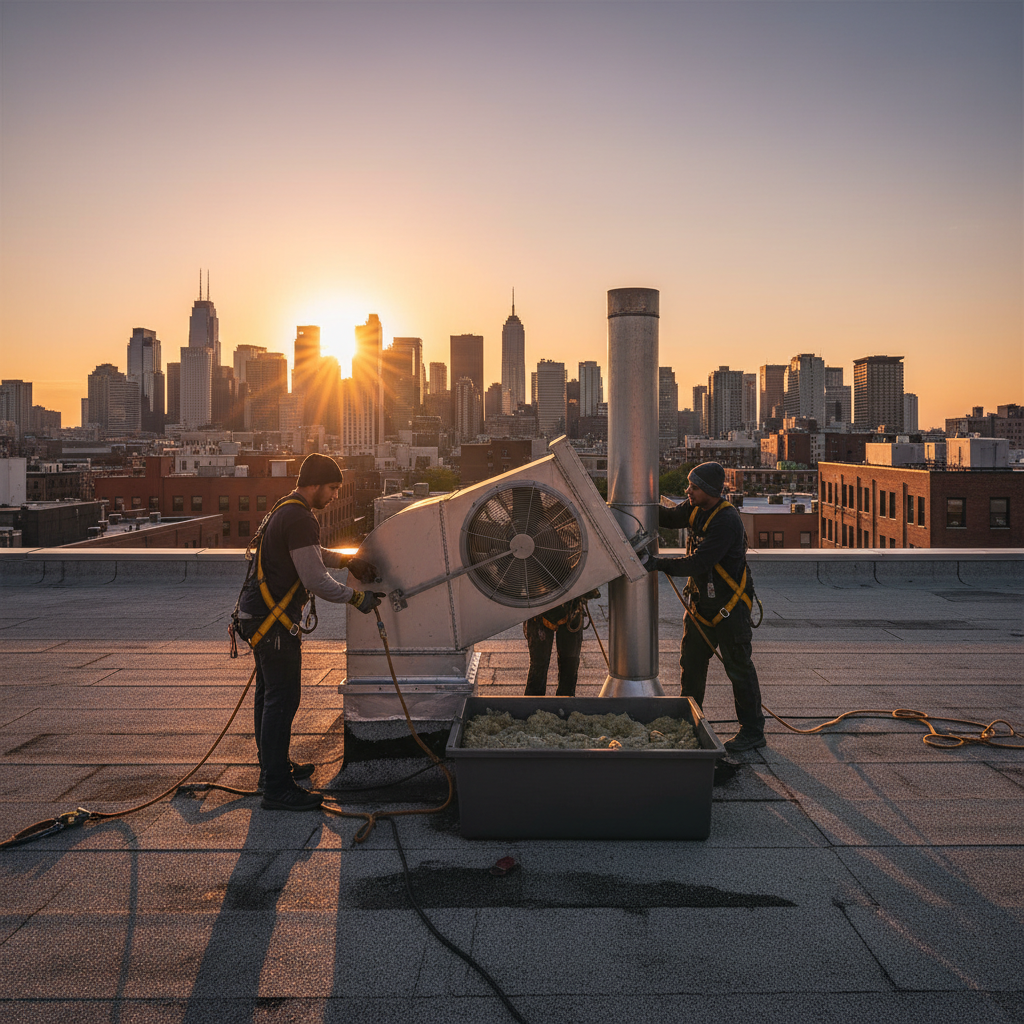
- Service the exhaust fan: Hinge the fan safely, clean blades and housing, check bearings, verify alignment, and replace worn belts when needed.
- Reset grease containment: Empty rooftop boxes, replace saturated media, and confirm proper drainage to protect the roof membrane.
- Final QC and documentation: Inspect surfaces, photograph results, apply the service sticker, and issue a report with next-due date.
Where steam is appropriate, rinse temperatures exceeding 180°F accelerate emulsification and shorten total dwell time. Hinge kits protect wiring and reduce strain on fan housings, often trimming future labor on rooftop steps and improving safety.
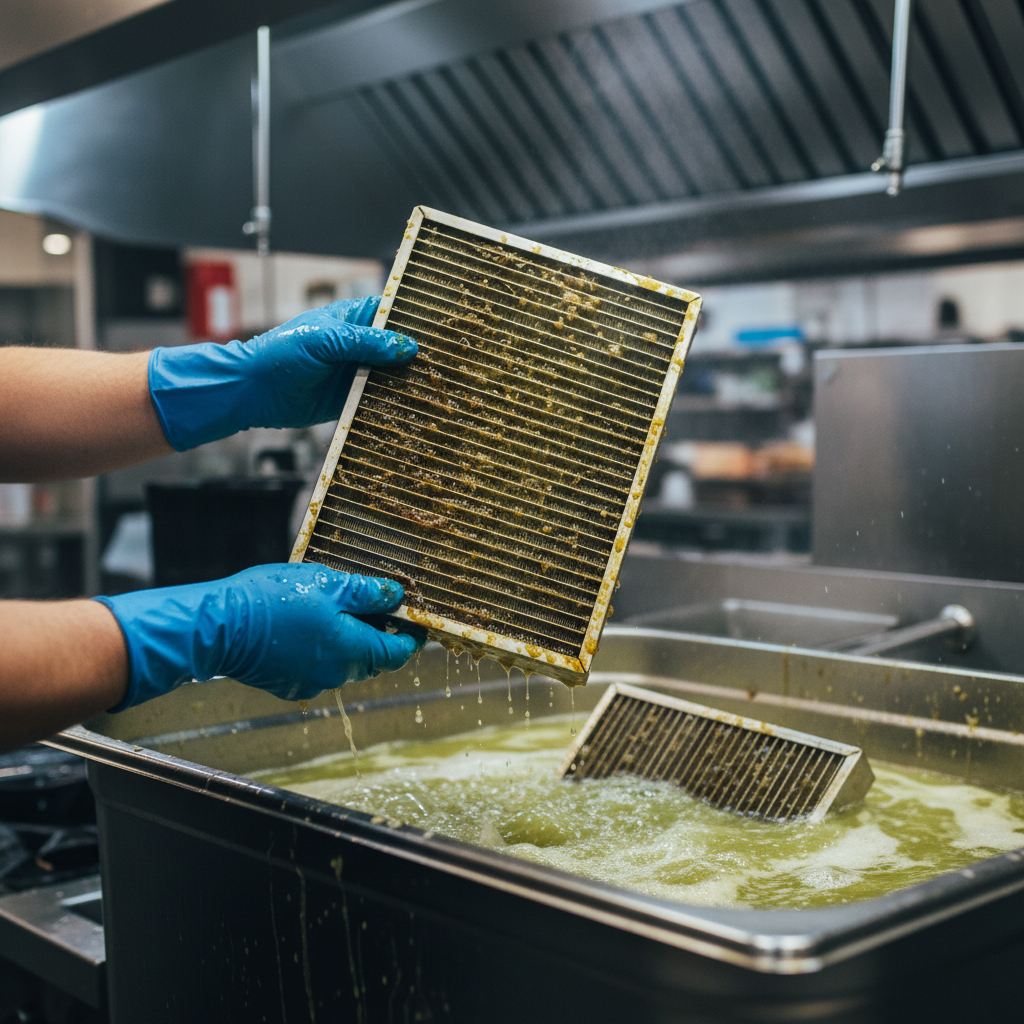
For a complementary perspective on vents, access points, and quick checks your team can do, see our concise kitchen ventilation cleaning guide. It pairs well with the step-by-step process above.
Types, Methods, and Approaches
Technicians combine chemical foam, hot-water or steam rinsing, targeted scraping, filter exchange, and fan-belt service. The goal is to reach bare-metal where required, minimize downtime, and protect assets like motors and roofs throughout the hood-to-fan path.
Common field methods
- Chemical foam degreasing: Foam clings to vertical duct walls and dissolves heavy deposits—useful in long risers and complex geometry.
- Hot-water/steam rinsing: High temperatures speed grease breakdown and carry soils to containment.
- Scraping and brushing: Mechanical removal targets hardened layers in elbows, transitions, and fan housings before the final rinse.
- Filter cleaning & exchange: Rotational exchanges keep capture efficiency high between deep services, reducing smoke roll-out.
- Fan belt inspection/replacement: Tension and wear checks during cleaning prevent post-service surprises and protect airflow.
When to choose which
- High-volume frying: Foam plus hot rinse usually restores capture fastest with the least rework.
- Charbroiler or solid fuel: Expect more scraping; plan for added access doors on long verticals and detailed brushing.
- Multi-tenant food courts: Coordinate shared shafts and standardize filter exchanges to keep stations in sync.
Looking to align method with risk? Our overview of kitchen exhaust fire hazard reduction explains how method selection changes with menu and fuel type.
Process table: matching method to scenario
| Scenario | Primary Method | Supporting Steps | Typical Interval |
|---|---|---|---|
| High-volume fryers | Foam + hot rinse | Filter exchanges; belt check | Quarterly |
| Charbroiler/solid fuel | Scrape + foam | Added access doors; steam | Monthly |
| Light-duty sauté | Foam + rinse | In-house filter wash | Semiannual |
| Institutional kitchen | Foam + brush | Portfolio calendar | Quarterly/Semiannual |
| Food court (shared) | Coordinated deep clean | Containment reset | Quarterly |
Best Practices and Recommended Frequency
Set frequency by cooking intensity: monthly for solid-fuel or heavy frying, quarterly for high volume, semiannual for moderate, and annual for light-duty. Combine filter management, access-door upgrades, rooftop containment, and photo-backed reports to keep inspections predictable.
Scheduling and compliance
- Interval alignment: NFPA 96 recognizes a 1–6 month range tied to volume and fuel type; choose the shortest that fits your operation.
- Access matters: Code-compliant doors let techs reach elbows and verticals for thorough outcomes.
- Filter discipline: Weekly in-house washing or an exchange program stabilizes capture between deep cleans.
- Rooftop protection: Grease boxes and absorbent media prevent membrane damage and slip hazards after rain.
- Documentation: Keep the latest report, sticker, and photos on file for audits and renewals.
Local considerations for All Over Ontario
- Plan winter roof access with safe pathways and de-icing so rooftop fan service remains on schedule.
- Book before long weekends; summer patios and tourism typically increase volume and speed grease buildup.
- In shared-duct food courts, coordinate access windows with neighboring vendors to avoid conflicts.
If you need a quick cadence reference, our short piece on kitchen exhaust code requirements summarizes volume-based intervals and pre-service prep.
Tools and Resources
Professionals use food-safe degreasers and foamers, hot-water or steam rinse systems, scrapers and drill-driven brushes, access-door and hinge kits, rooftop grease containment, and lockout/fall-protection gear. These tools enable deep cleaning, worker safety, and long-term protection of fans and roofs.
- Degreasers & foamers: Foam clings to verticals, lifting carbonized soil for efficient rinsing and faster resets.
- Heated rinse systems: Hot water accelerates emulsification, often cutting dwell times.
- Manual removal: Scrapers and brushes target hardened layers in tight geometry like elbows and transitions.
- Hardware upgrades: Access doors and hinge kits reduce repeat labor and protect wiring and roof membranes.
- Safety systems: Lockout/tagout, harnesses, anchors, and controlled water containment reduce incident risk.
Inspection-ready results, one coordinated visit. Robinhood Cleaners delivers NFPA 96–aligned hood, duct, and fan cleaning across Ontario with 24/7 scheduling. Add-ons include filter cleaning & exchange, fan belt replacement, grease trap cleaning, and power washing.
Explore our broader restaurant kitchen cleaning services to unify safety, hygiene, and documentation.
Case Studies and Examples
Ontario operators see fewer alarms, steadier capture, and cleaner audits when the full hood-to-fan path is serviced and documented. These brief scenarios reflect common problems and fixes that delivered measurable improvements in safety and uptime.
Quick-service fryer line (regional chain)
- Problem: Nuisance alarms during lunch; streaking at filter edges; hot, smoky line.
- Findings: Overloaded filters, deposits at the first elbow, unbalanced rooftop fan, and a worn belt.
- Fix: Full hood-to-fan clean, filter exchange enrollment, new belt + hinge kit, rooftop grease containment reset.
- Outcome: No alarms the following month; noticeable heat reduction on the line and faster capture.
Fine-dining charbroiler (single location)
- Problem: Odor complaints in the dining room and weak capture when the front door opened.
- Findings: Resinous deposits from char; missing access doors on a long vertical run.
- Fix: Added access panels; foam plus steam rinse; detailed fan blades and housing.
- Outcome: Stronger hood-edge capture and improved perceived air quality for guests.
Institutional kitchen (multi-station)
- Problem: Inconsistent records; two stations overdue by a quarter.
- Findings: Duct sections lacked access; rooftop containment saturated and overflowing.
- Fix: Portfolio calendar across stations; added access doors; reset containment; standardized photo logs.
- Outcome: Clean audits at next review; synchronized intervals and fewer surprises.
For managers building checklists and SOPs, our overview of commercial kitchen exhaust cleaning services outlines daily, weekly, and quarterly touchpoints you can assign without interrupting service.
Frequently Asked Questions
Across restaurants and institutional kitchens, questions cluster around cadence, scope, prep, and safety. Here are direct answers you can act on today to keep your system clean, documented, and compliant.
How often should we schedule exhaust cleaning?
Match service to volume: monthly for solid-fuel or heavy frying, quarterly for high volume, semiannual for moderate, and annual for light-duty. Recognized ranges are outlined in NFPA 96; choose the shortest interval that fits your risk profile.
What parts must be cleaned to stay compliant?
Clean the complete path: canopy hood and plenum, baffle filters, horizontal and vertical ducts, the exhaust fan, and rooftop grease containment. Document work with photos, a current service sticker, and a brief report.
Can we handle filter washing in-house and still use a pro?
Yes. Weekly filter washing or a formal exchange program keeps capture efficiency high. Pros should still deep-clean ducts and fans. Pairing both approaches reduces smoke roll-out and stabilizes airflow between visits.
How should we prepare the kitchen for service?
Clear prep areas near the line, remove or cover open food, and secure smallwares. Coordinate rooftop or mechanical room access. Pick an off-peak window—overnight or early morning—so equipment is cool and downtime is minimal.
What safety practices matter during cleaning?
Conclusion and Key Takeaways
Restaurant kitchen exhaust cleaning reduces fire risk, supports compliance, and stabilizes airflow. Tie the schedule to cooking volume, clean every surface from hood to fan, and document each visit. The payoff is safer teams, smoother inspections, and more reliable uptime.
- Clean the full path: Hood, baffle filters, ducts, exhaust fan, and rooftop containment.
- Right cadence: Monthly to annual based on menu, hours, and fuel type.
- Proof matters: Photo logs, reports, and current stickers speed audits and renewals.
- Simple upgrades: Access doors, hinge kits, and filter exchanges cut future labor and risk.
Ready to coordinate multiple Ontario locations in one window? We can align hood, duct, fan, filter exchange, grease trap cleaning, and fan belt replacement so your team starts the next shift with clean, efficient ventilation. Explore our exhaust hood & vent cleaning guide for a deeper look at inspection points.
Related Articles
To round out your program, pair full-path exhaust service with a documented restaurant kitchen cleaning plan and routine exhaust fan maintenance checks. These connected practices reinforce fire safety, hygiene, and reliable airflow across busy shifts.