Kitchen cleaning is the systematic removal of grease, food residue, and pathogens from all kitchen surfaces and ventilation systems to maintain safety and sanitation. For restaurants in All Over Ontario, consistent cleaning reduces fire risk, improves air quality, and helps pass inspections. Robinhood Cleaners supports this with certified exhaust, hood, and equipment services.
By Robinhood Cleaners • Last updated: 2026-05-29
Quick summary
Commercial kitchen cleaning keeps food areas, equipment, and ventilation systems free from grease and microbes. Do daily wipe-downs, weekly equipment detailing, monthly deep cleans, and exhaust-system service every 1–6 months based on volume. Pair checklists with trained staff and, for high-heat cooking, schedule NFPA 96–aligned hood and duct cleaning.
This complete guide is written for restaurant and foodservice teams. You’ll find definitions, step-by-step checklists, safety notes, a buying guide, and a DIY-versus-pro comparison. We also include Ontario-specific considerations and real examples from our crews working All Over Ontario.
- What kitchen cleaning covers and why it matters
- Daily, weekly, monthly, and quarterly tasks (step-by-step)
- Exhaust, hood, duct, and fan maintenance intervals (1–6 months)
- Grease trap practices and equipment sanitizing sequences
- DIY vs. professional: comparison table and selection tips
Table of contents
Use this table of contents to jump to the section you need. Each section provides a concise summary first, then deeper, step-by-step instructions and tools. Bookmark this page and share it with your back-of-house leads for consistent results shift after shift.
- What is kitchen cleaning?
- Why kitchen cleaning matters
- How kitchen cleaning works (step-by-step)
- Types and methods
- Best practices and safety
- Tools and resources
- Buying guide + comparison
- Case studies and examples
- Local and seasonal context
- Frequently Asked Questions
- Conclusion
- Key takeaways
What is kitchen cleaning?
Kitchen cleaning refers to the routine and deep removal of grease, soils, and microbes from food-contact areas, equipment, floors, and ventilation systems. For commercial kitchens, this includes hoods, ducts, and exhaust fans cleaned on a 1–6 month cadence, supported by daily and weekly line-level tasks and documented sanitation.
In plain terms, it’s everything you do to prevent contamination, reduce fire hazards, and keep air moving. In our experience, kitchens that pair a daily surface routine with scheduled exhaust maintenance see steadier temperatures on the line and fewer smoke events during rush periods.
- Scope: Prep tables, cutting boards, coolers, grills, ovens, fryers, floors, walls, ceilings, hoods, ducts, fans, and grease traps.
- Cadence: Daily wipe-down and sanitizing, weekly equipment detailing, monthly deep cleans, and 1–6 month exhaust service based on cooking volume.
- Documentation: Log sheets for opening/closing, chemical Safety Data Sheets (SDS), and service certificates for hood/duct cleaning.
Robinhood Cleaners focuses on the high-risk, high-skill parts of this spectrum: kitchen exhaust hood cleaning, duct and fan degreasing, filter cleaning/exchange, grease trap service, and commercial appliance deep cleaning.
Why kitchen cleaning matters
Effective kitchen cleaning reduces fire risk, prevents cross-contamination, and stabilizes ventilation. Clean hoods and ducts move air better, while sanitized prep areas cut pathogen transfer. The result is safer staff, consistent food quality, and smoother inspections—especially in high-heat, high-volume Ontario operations.
Here’s the thing: grease accumulates quickly on hot equipment and in ducts. Without regular removal, ignition risk climbs with every service day. Likewise, poorly cleaned reach-ins and prep tables raise the odds of foodborne illness. Teams that maintain steady routines report fewer callbacks, steadier line temperatures, and less downtime.
- Fire prevention: Exhaust systems accumulate grease aerosol; cleaning every 1–6 months curbs ignition risk.
- Food safety: Sanitizing food-contact surfaces after each task interrupts contamination cycles.
- Ventilation stability: Degreased fans maintain airflow, which supports hood capture and cooler, safer workstations.
- Compliance confidence: Logs and service certificates demonstrate due diligence to inspectors and insurers.
For operators balancing tight labor and peak traffic, good cleaning also saves time. A consistent 10–15 minute closing routine per station prevents the 90-minute “catch-up clean” at week’s end.
How kitchen cleaning works (step-by-step)
Structure your program by cadence: daily sanitizing and degreasing, weekly equipment detailing, monthly deep cleans, and exhaust system service on a 1–6 month interval. Use checklists, color-coded tools, and documented sign-offs. Assign owners for each station and for hoods, ducts, fans, and grease traps.
Daily opening and line checks (10–20 minutes)
- Wash, rinse, sanitize all prep tables and cutting boards before food contact.
- Verify hood filters are seated; replace if visibly clogged.
- Empty and reliner waste bins; check floor mats and anti-slip placement.
- Spot-degrease high-heat splash zones around fryers and grills.
During service (ongoing)
- Wipe and sanitize between raw and ready-to-eat tasks.
- Swap wiping cloths every 4 hours or when soiled; refresh sanitizer buckets.
- Skim fryer oil and lid when off-line to reduce aerosolized grease.
- Keep filters upright; if smoke “rolls out,” investigate capture and airflow.
Closing routine (20–40 minutes per station)
- Scrape, wash, rinse, sanitize all food-contact surfaces; air-dry.
- Degrease backsplashes, equipment sides, and hood undersides.
- Lift-equipment clean: under fryers, grills, and ranges as feasible.
- Mop floors with degreaser, then sanitize; squeegee to drains.
Weekly and monthly deep work
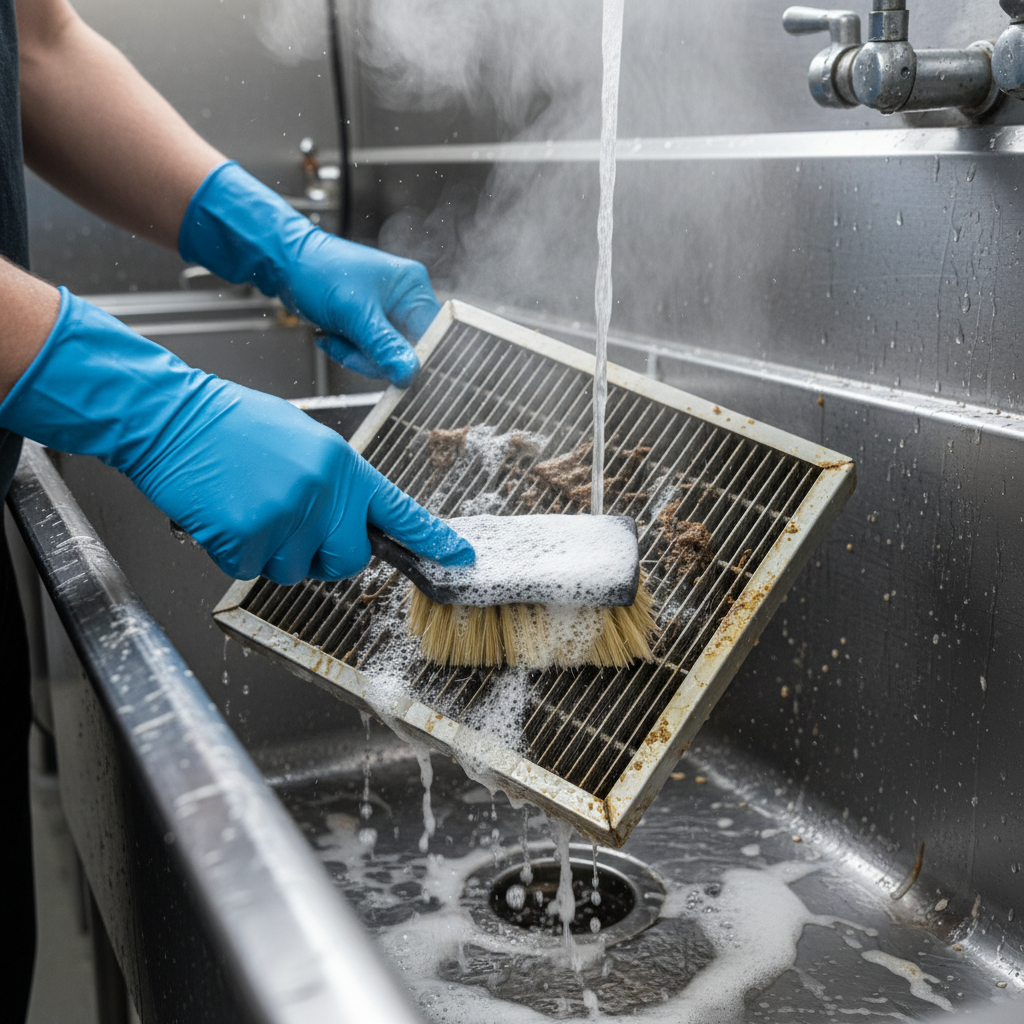
- Disassemble and soak hood filters; rotate in a cleaned set.
- Detail clean ovens, grills, and refrigeration gaskets and rails.
- Power wash or scrub hard-to-reach floors and wall bases.
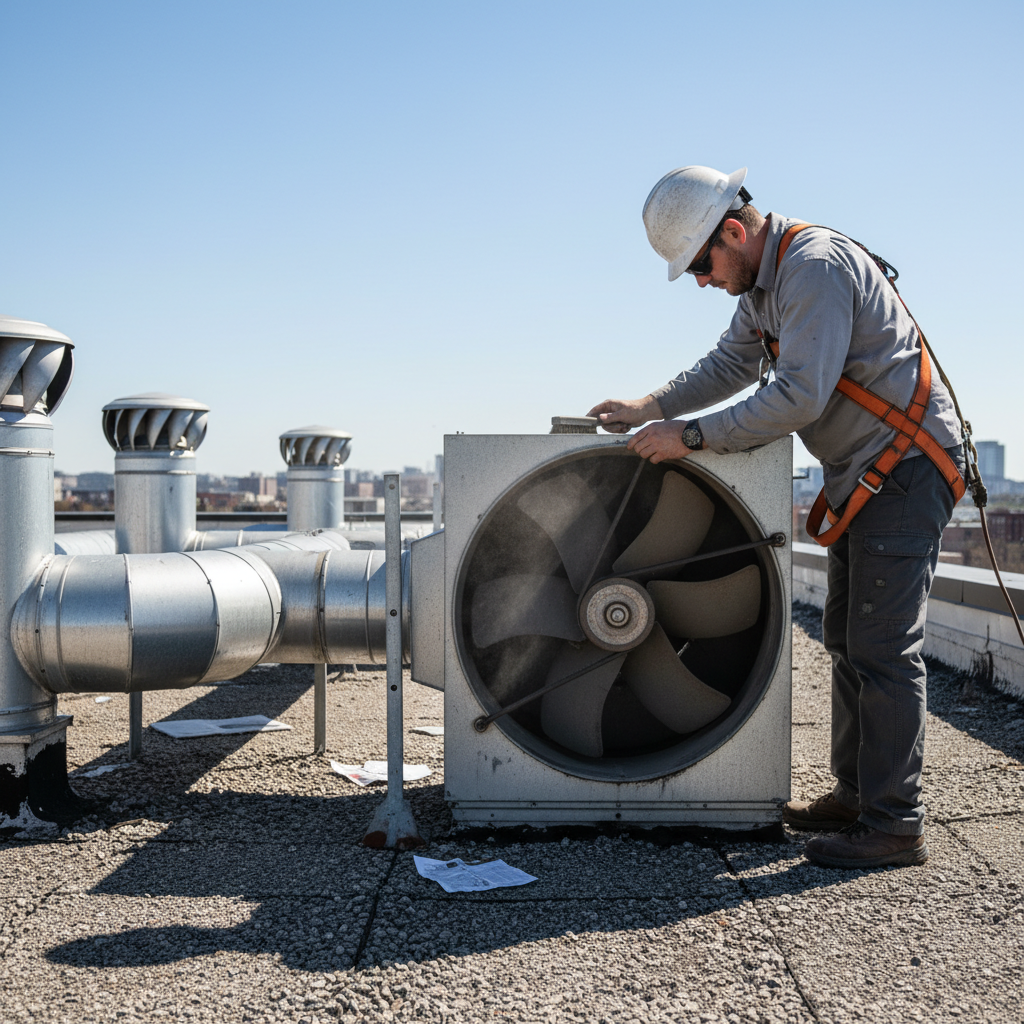
- Inspect exhaust fan belts and housings for wear, vibration, or noise.
For exhaust systems, our teams document hood, duct, and fan degreasing with before-and-after photos and certificates. If you need a framework, see our kitchen vent cleaning guide and this commercial exhaust cleaning overview.
Types and methods
Organize tasks by area and intensity: surface sanitizing (multiple times daily), equipment detailing (weekly), deep cleaning (monthly), and ventilation cleaning (every 1–6 months). Include grease trap maintenance and filter exchange so airflow and drainage stay consistent under peak loads.
Surface sanitizing
- Wash, rinse, sanitize sequence for all prep areas after each task.
- Color-code tools to separate raw protein zones from ready-to-eat zones.
- Refresh sanitizer at least every 4 hours during service.
Equipment detailing
- Grills and flat-tops: scrape while hot, degrease nightly, polish weekly.
- Ovens and ranges: remove racks, soak, degrease chambers monthly.
- Refrigeration: clean gaskets, rails, and drip pans monthly to prevent odor.
Ventilation system cleaning
- Hood interior and plenum: degrease monthly touch-ups; schedule full service on 1–6 month cadence.
- Duct runs: remove grease to bare metal; document with photos.
- Exhaust fans: clean blades and bowls; verify belt tension and bearings.
Grease trap maintenance
- Skim solids and fats routinely; pump at intervals recommended by local bylaws.
- Record pump-outs and visual checks to prevent backups.
- Coordinate with hood service to align heavy-degrease days.
Need help sequencing tasks? Our restaurant kitchen cleaning services integrate equipment, floors, and ventilation so nothing gets missed between shifts.
Best practices and safety
The best kitchen cleaning programs standardize routines, verify chemical contact times, and log completion. For fire safety, clean hoods, ducts, and fans on a 1–6 month schedule and keep proof of service. Use PPE, lockout-tagout for equipment, and SDS for every chemical on-site.
Safety first
- Wear gloves and eye protection when handling degreasers.
- Use non-slip shoes; place wet floor signs during mopping.
- Confirm electrical lockout before deep-cleaning powered equipment.
Chemical controls
- Verify dilution ratios; stronger is not always better for food-contact surfaces.
- Respect contact times so sanitizers do their job.
- Store acids and alkalis separately; label secondary containers.
Documentation and training
- Keep opening/closing checklists at each station and in supervisor binders.
- Log exhaust cleanings with certificates and photo documentation.
- Train new hires in the wash–rinse–sanitize sequence on day one.
For higher-volume, high-heat operations, we recommend monthly hood touch-ups and quarterly to semi-annual full-system service. For lighter use, semi-annual or annual may suffice, provided there’s no visible grease beyond a thin film.
Tools and resources
Equip your team with color-coded cloths and cutting boards, degreasers and sanitizers, scraper tools, and long-handle brushes. Keep a spare set of hood filters to enable same-day exchanges. For ventilation, partner with certified pros for hoods, ducts, fans, and belts.
- Surfaces: microfiber cloths, food-safe sanitizer, utility scrapers, doodle pads.
- Equipment: grill stones, oven-safe degreasers, gasket brushes.
- Ventilation: extra filter sets, plenum-safe degreasing agents.
- Floor care: deck brushes, squeegees, grease-cutting cleaners.
- Records: laminated checklists, service certificates binder.
For a filter rotation plan and exchange cadence, explore our hood filter cleaning guide and our page on filter replacement. For whole-system service, review our commercial exhaust cleaning overview.
Buying guide: DIY vs. professional service
Use DIY for surface sanitation and routine equipment wipe-downs. Bring in certified pros for hoods, ducts, fans, belts, and grease traps. Choose providers with documented before/after photos, service certificates, and 24/7 scheduling to match your operating hours.
What to evaluate
- Scope fit: Does the provider cover hoods, ducts, fans, filter exchange, and grease trap service?
- Credentials: NFPA 96–aligned methods, insured technicians, and safety training.
- Proof: Photo documentation and certificates after each service.
- Scheduling: Off-hours availability to avoid downtime.
| Approach | What it covers | Time investment | Fire risk reduction | Documentation | Best for |
|---|---|---|---|---|---|
| DIY only | Surfaces, light equipment wipe-downs | Daily routines by staff | Limited (no duct access) | Station checklists | Low-volume prep, ghost kitchens with minimal frying |
| Hybrid | DIY surfaces + scheduled hood/duct service | Daily + quarterly/sem i-annual visits | High (ducts and fans degreased) | Checklists + service certificates | Most restaurants and food courts |
| Professional-led | End-to-end: hoods, ducts, fans, belts, traps, equipment | Off-hours crew; minimal kitchen labor | Highest (bare-metal duct outcomes) | Full documentation and photos | High-heat, high-volume or multi-site operations |
If you’re evaluating vendors, our Ontario-focused service pages explain scope and scheduling in detail. See this 24/7 overview for operators working around the clock, and compare scope on commercial hood cleaning in Ontario. For heavy-degrease days, review power washing and degreasing considerations.
Case studies and examples
Here are three Ontario scenarios that show how cadence and scope change outcomes: a quick-service line, a fine-dining kitchen, and an institutional cafeteria. In each case, pairing daily routines with exhaust service every 1–6 months stabilized airflow and simplified inspections.
Quick-service line: fry-heavy, long hours
- Challenge: Persistent smoke and hot line during dinner rush.
- Action: Monthly hood touch-ups; quarterly full-system degrease; filter exchange twice weekly.
- Outcome: Noticeable reduction in smoke roll-out and steadier capture at the hood.
Fine dining: varied menu, precision plating
- Challenge: Odor carryover to dining room on tasting-menu nights.
- Action: Duct and fan cleaning semi-annually; gasket detailing monthly; expanded closing checklist.
- Outcome: Improved air quality front-of-house and smoother white-glove inspections.
Institutional cafeteria: high volume, multiple stations
- Challenge: Consistency across stations and shifts.
- Action: Laminated, color-coded checklists; quarterly exhaust service; grease trap pump-outs on a set interval.
- Outcome: Fewer post-rush deep cleans and faster reopen after service.
Want a deeper dive into hot-side degreasing? Our commercial kitchen hood cleaning guide and exhaust service overview show bare-metal outcomes with photo documentation.
Local and seasonal context
In All Over Ontario, temperature swings and patio season change grease loads and airflow. Plan more frequent filter exchanges during summer rush and schedule off-hours hood service before holidays. Align grease trap pump-outs with seasonal menu shifts to avoid backups.
Local considerations for All Over Ontario
- Patio season increases fry volume—rotate hood filters more frequently and consider monthly hood touch-ups before peak weekends.
- Winter brings closed doors and heavier indoor air loads—confirm fan belts and bearings before the holiday rush.
- Regional inspections emphasize documentation—keep service certificates and photo logs in a dedicated binder at the manager’s station.
Operating across shifts? This Ontario-focused overview highlights risks and timing for teams that run late or 24/7. See: Are you at risk?
Free readiness check (soft CTA)
- We’ll review your current cadences (daily/weekly/monthly/1–6 months).
- We’ll suggest a filter rotation and exhaust schedule that matches volume.
- We’ll align service windows with your slowest hours.
Prefer off-hours? Our team is available 24/7 across Ontario.
Frequently Asked Questions
These concise answers cover the schedules, scope, and documentation operators ask about most. Use them to train leads and standardize expectations across shifts and locations.
How often should a commercial kitchen schedule hood and duct cleaning?
Most high-heat, high-volume kitchens benefit from quarterly service, with monthly touch-ups on the hood interior. Moderate use often aligns with semi-annual service. Low-volume operations may extend to annual intervals if there’s minimal visible grease.
What should be included in a professional kitchen cleaning service?
A complete scope covers hoods, ducts, exhaust fans, belt checks, and filter exchange, plus grease trap maintenance on an agreed interval. You should receive before-and-after photos and a service certificate for your records and inspections.
Can our staff handle all kitchen cleaning tasks in-house?
Staff can handle daily sanitizing, equipment wipe-downs, and closing routines. For hoods, ducts, fans, belts, and grease traps, use certified professionals with the right equipment and documentation to ensure safety and compliance.
What documentation do inspectors usually ask for?
Keep opening/closing checklists, chemical SDS, temperature logs, and service certificates for hood, duct, and fan cleaning. Photo documentation is helpful to demonstrate bare-metal outcomes in ducts and fan bowls.
Conclusion
Build your kitchen cleaning plan around cadence: daily, weekly, monthly, and 1–6 month ventilation service. Standardize checklists, train staff on contact times, and document exhaust work with photos and certificates. This approach reduces fires, stabilizes airflow, and speeds inspections.
Robinhood Cleaners supports Ontario restaurants with certified hood, duct, and fan cleaning; filter exchange; fan belt replacement; grease trap service; and deep appliance cleaning. Explore our exhaust cleaning overview or our grease removal guide to align the right services with your menu and volume.
Key takeaways
Commercial kitchen cleaning works best when daily surface routines support scheduled ventilation service. Track tasks, rotate filters, and document hood/duct work. For high-heat cooking, plan monthly hood touch-ups and quarterly system cleanings to keep airflow stable and staff safe.
- Use a four-part cadence: daily, weekly, monthly, 1–6 month exhaust service.
- Rotate hood filters; keep a clean spare set ready.
- Document services with photos and certificates for inspections.
- Match schedules to volume and seasonality in All Over Ontario.
- Leverage professional support for ducts, fans, belts, and grease traps.