Ontario food-service local guide
Ontario Restaurant Grease Trap Pumping Checklist
Short answer: verify the restaurant’s municipality and sewer-use rules, identify the exact interceptor and manufacturer requirements, review maintenance records, define pumping and disposal scope, make access safe, document starting and final conditions, obtain proof of lawful disposal, update the on-site log and correct any unresolved defect.
Local-rule warning: there is no single pumping frequency or procedure for every Ontario restaurant. Municipal bylaws, device standards, manufacturer instructions and inspection directions differ. This checklist is not legal, plumbing, confined-space or environmental advice. Do not open or enter unsafe equipment or use chemicals to push grease through an interceptor.
First verify the municipality and governing requirements
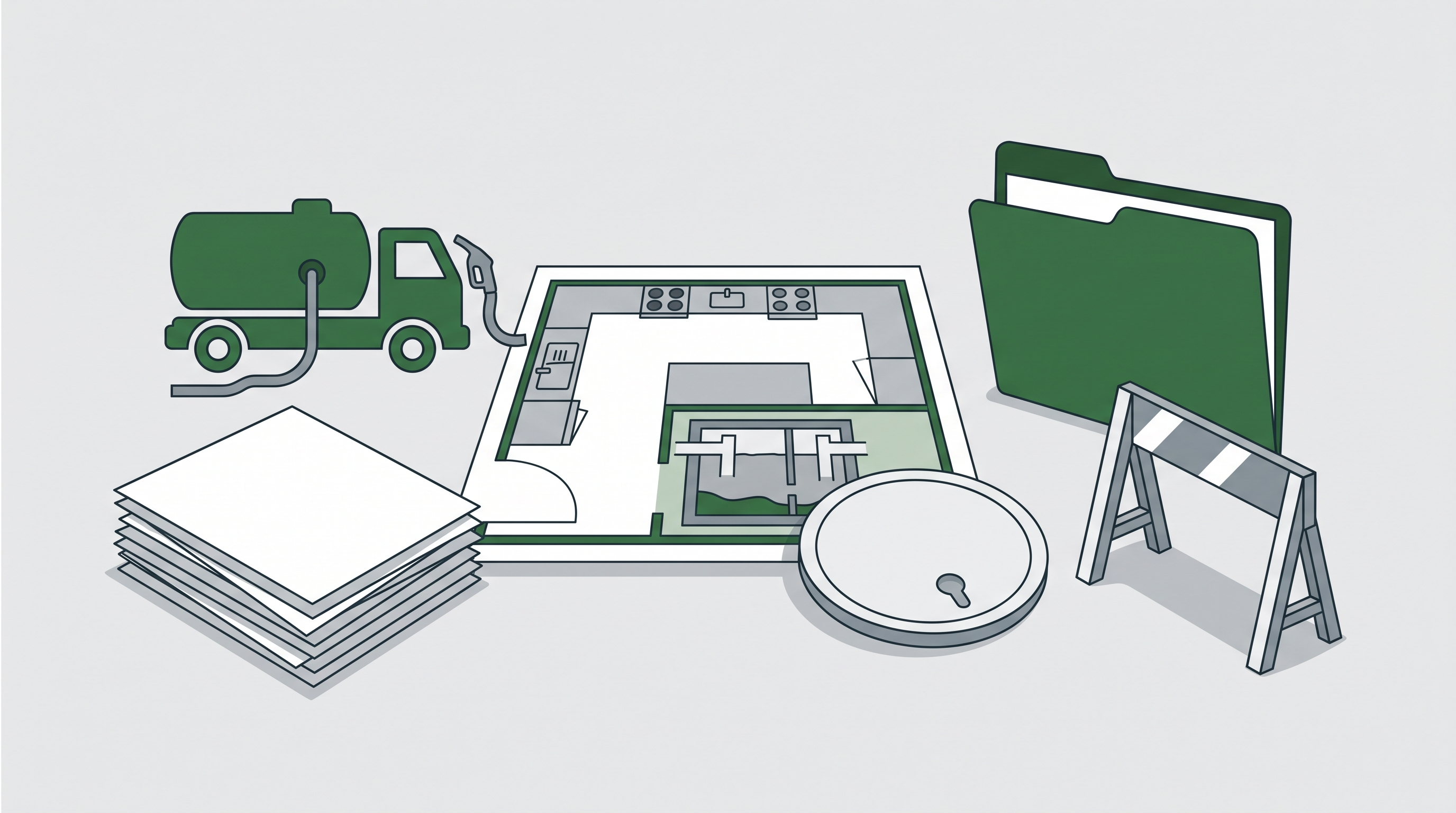
Start with the restaurant’s exact address and identify the municipal or regional sewer authority. Do not apply Toronto, York Region or another municipality’s rules automatically to a different site. Record the current bylaw link, contact, device requirement, maintenance standard, record-retention period, inspection history and any site-specific order.
The City of Toronto’s current grease interceptor guidance says food-service establishments must properly install, operate and maintain an interceptor and explains that device types and access differ. York Region’s Sewer Use Bylaw requires records and proof of interceptor clean-out and disposal. These are examples of why the local check comes first, not universal Ontario instructions.
Ask whether installation, replacement or modification requires a permit and qualified plumbing work. A pumping contractor should not silently convert a maintenance visit into equipment alteration. If a municipal inspector has provided direction, add it to the job package and confirm who is responsible for closing it.
Identify the exact interceptor and maintenance basis
Create an equipment record with manufacturer, model, size or rated capacity, type, location, connected fixtures, installation drawing, flow direction, access covers and prior service history. A small hydromechanical unit near a fixture and a large gravity interceptor outside do not have the same access, pumping or safety plan.
Locate manufacturer instructions and any posted maintenance requirements. Review the last clean-out date, measured accumulation if recorded, changes in kitchen volume or menu, backups, odours, slow drains, repairs and inspection notes. These observations do not establish the cause; they help the appropriate professional scope the visit.
Do not set a schedule from a blog alone. York Region publishes current grease-interceptor guidance and prohibits using specified enzymes, bacteria, solvents, hot water or other agents to facilitate grease passage. Requirements and wording must be checked for the site. The operator should build a calendar from the applicable bylaw, device standard, manufacturer instructions and actual accumulation evidence.
Select the pumping provider with a written scope
| Quote field | What to verify | Stop condition |
|---|---|---|
| Site eligibility | Municipality, device type, access and service area accepted in writing | Provider cannot confirm the job or territory |
| Qualifications | Training, insurance and any required approvals for the exact work | Claims cannot be documented |
| Removal scope | Contents, solids, accessible surfaces and exclusions | “Pumping” is not defined |
| Disposal | Carrier, destination, manifest or proof supplied | Waste chain is unexplained |
| Safety | Traffic, covers, gases, PPE, confined-space and spill responsibilities | Unsafe access or roles remain unresolved |
| Restoration | Cover, seals, water level, area cleanup and damage process | No post-service verification |
| Documentation | Dates, quantities if measured, photos, defects, receipt and next action | Operator cannot maintain required records |
| Total | Base work, travel, after-hours, excess material, tax and extra work approval | Price can expand without approval |
Robinhood Cleaners publishes grease trap cleaning among its services. That supports requesting a quote, not assuming the company pumps every device, serves every Ontario address, holds a particular licence or uses a specific disposal facility. Confirm the table above for the actual restaurant.
Prepare safe access without disrupting food operations
Choose a service window around the restaurant’s operating and wastewater schedule. Identify who shuts down connected fixtures, who controls customer and staff access, and when the kitchen may resume use. Follow the provider, manufacturer and qualified professional instructions; this guide does not prescribe isolation or restart steps.
Clear the route and protect food, food-contact surfaces, equipment and floors. For an outdoor interceptor, address vehicle and pedestrian traffic, weather, lighting and access to covers. For an indoor unit, plan ventilation, splash containment and safe separation from food preparation. Keep unauthorized staff away.
Never ask restaurant staff to lift a heavy or unsafe cover, enter an interceptor, test gases, handle waste or improvise confined-space work. The provider must define safe-work responsibilities. Stop the appointment if access differs from the quote, the device cannot be identified, a cover is damaged, a hazardous atmosphere is suspected or the provider proposes an unapproved method.
Before service, photograph the device exterior, surrounding area, labels and accessible condition without exposing staff to hazards. Record existing leaks, damage, odours, backups or municipal notices. Photos support the handoff; they are not proof of compliance or internal condition.
Record the service without turning it into a DIY procedure
The restaurant’s representative should verify the provider, work order and device before work starts. Confirm the disposal paperwork that will be supplied and the approval contact for changed scope. The contractor—not untrained restaurant staff—performs the technical pumping and cleaning under its safe work procedures.
Record arrival and departure, device identifier, service performed, observations, material or quantity data if the provider measures it, any part removed or replaced, and any area left inaccessible. Ask the provider to identify damage, missing components or suspected installation problems without making repairs outside the approved scope.
Do not add enzymes, bacteria, solvents or hot water to move grease downstream. York Region explicitly prohibits specified agents for this purpose, and the restaurant must verify its own municipality. Do not allow pumped contents to be discharged to a drain, storm system, ground or unexplained destination.
If there is a spill, unsafe condition, damaged line, sewage backup or other incident, stop routine operations and use the restaurant’s emergency, municipal, insurer and qualified-contractor procedures as applicable. This article cannot direct incident response.
Close the work with inspection, records and a next date
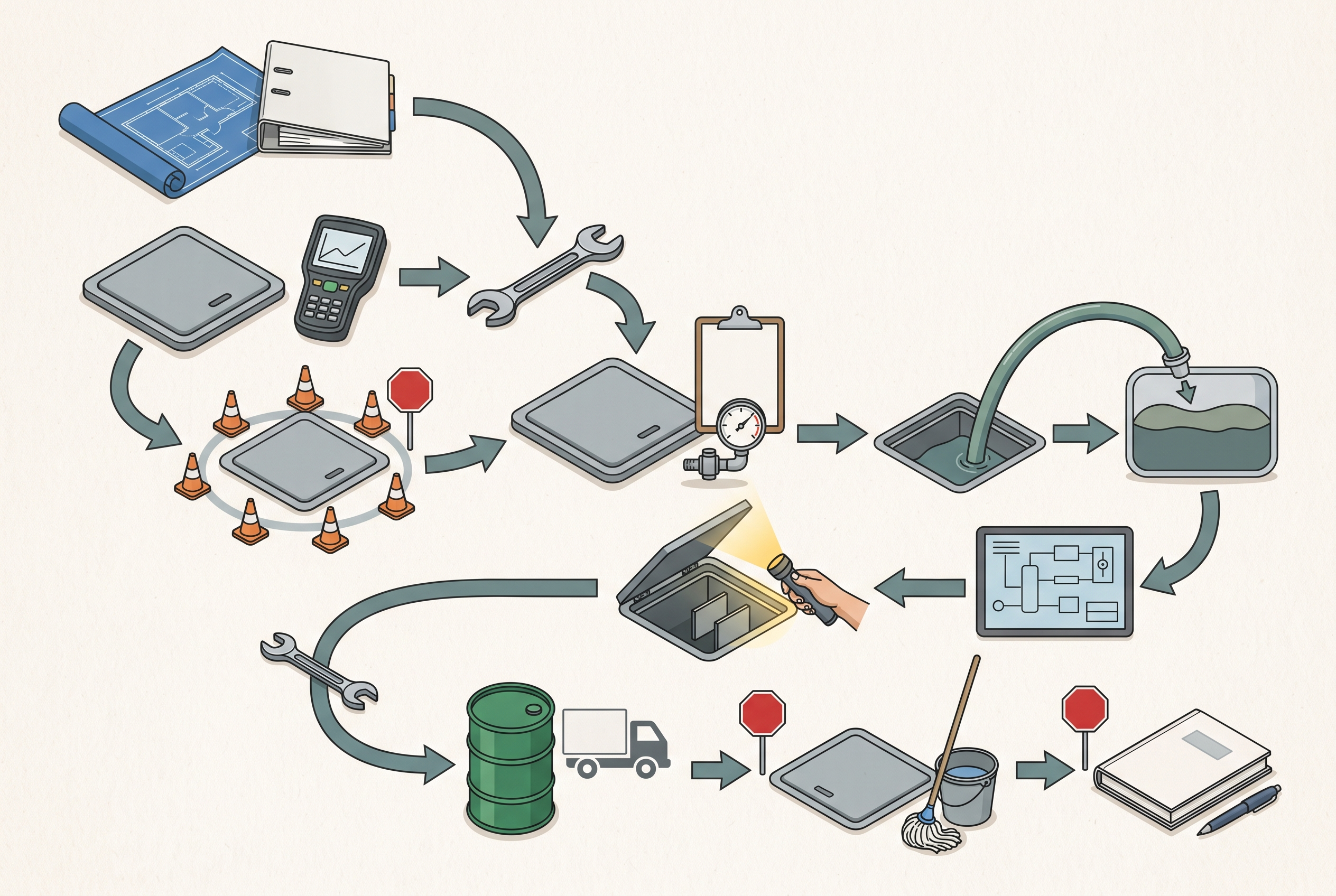
Before signing off, verify that covers and surrounding areas appear restored, connected areas are left according to the approved procedure, and the provider has documented any defect or limitation. Restaurant staff should not certify internal cleanliness they cannot safely see. Ask the appropriate professional about leaks, damaged baffles, missing flow-control components or installation concerns.
Collect the invoice, work order, before-and-after evidence, disposal manifest or receipt, observed condition, corrective recommendations and provider information. File records where an inspector can access them. Follow the actual municipal retention rule; York Region’s bylaw example calls for on-site proof for its stated period, but another municipality may differ.
Set the next review date using the governing rule, manufacturer instructions, accumulation record and operational changes. A calendar entry should trigger an inspection or service decision, not override a site-specific requirement. Update the schedule when menu, volume, hours, fixtures, device or municipal direction changes.
Copy this pumping appointment checklist
- Confirm the restaurant address and sewer authority.
- Save the current bylaw, inspection direction and record rules.
- Identify the interceptor, capacity, location and connected fixtures.
- Review manufacturer instructions and prior service evidence.
- Obtain a written scope, safe-work plan and complete total.
- Verify qualifications, insurance, service area and disposal documentation.
- Schedule around operations and secure the work zone.
- Record the starting exterior condition and existing issues.
- Confirm any scope change before work continues.
- Collect work and disposal records.
- Document defects and assign qualified follow-up.
- Update the on-site log and next review date.
Common pumping mistakes and compliance red flags
- Using one municipality’s schedule as a rule for all Ontario restaurants.
- Booking “grease trap service” without identifying the device and removal scope.
- Accepting unverified licence, insurance, territory or disposal claims.
- Letting untrained staff open covers, handle waste or enter a hazardous space.
- Using chemicals or hot water to force grease through the interceptor.
- Discharging waste to an unexplained location.
- Ignoring a damaged cover, baffle, seal, line or unsafe access condition.
- Failing to obtain a manifest, receipt, photos and maintenance record.
- Combining trap pumping with hood cleaning or general kitchen cleaning as if they were the same compliance task.
- Publishing or relying on a universal price, frequency or “inspection-ready” guarantee.
Frequently asked questions
How often must an Ontario restaurant pump its grease trap?
There is no safe universal answer. Check the restaurant’s municipal or regional bylaw, device standard, manufacturer instructions, actual accumulation and inspection directions.
Can restaurant staff clean the interceptor?
Only work that is lawful, within training and safe for the specific device should be performed. Do not have staff open or enter unsafe equipment, handle hazardous waste or improvise confined-space work.
What proof should a pumping provider give?
Ask for a work order, device and service details, observed defects, invoice, photos where appropriate and proof of lawful waste transport and disposal required by the local authority.
Does Robinhood Cleaners serve every Ontario restaurant?
This guide does not make that claim. Confirm the exact address, device, scope, qualifications, availability, reporting and price directly.
Request a municipality-specific service scope
Review Robinhood Cleaners’ published services and use the current contact information on its homepage to request a written quote. Provide the municipality, device record, access details and required documentation. Keep publication blocked until service-area, qualifications and local compliance claims are verified.