An operating-model comparison for commercial-kitchen filters
Compare Filter Programs for Ontario Commercial Kitchens
Short answer. Choose on-site cleaning when the kitchen has a safe service window and approved cleaning process; exchange rotation when clean compatible filters must be ready before the soiled set leaves; replacement-only when a filter is damaged, incompatible or no longer serviceable; and a hybrid when inspection results should trigger different actions. The program must identify the exact filter, authority requirements, service owner, clean inventory, records and stop conditions.
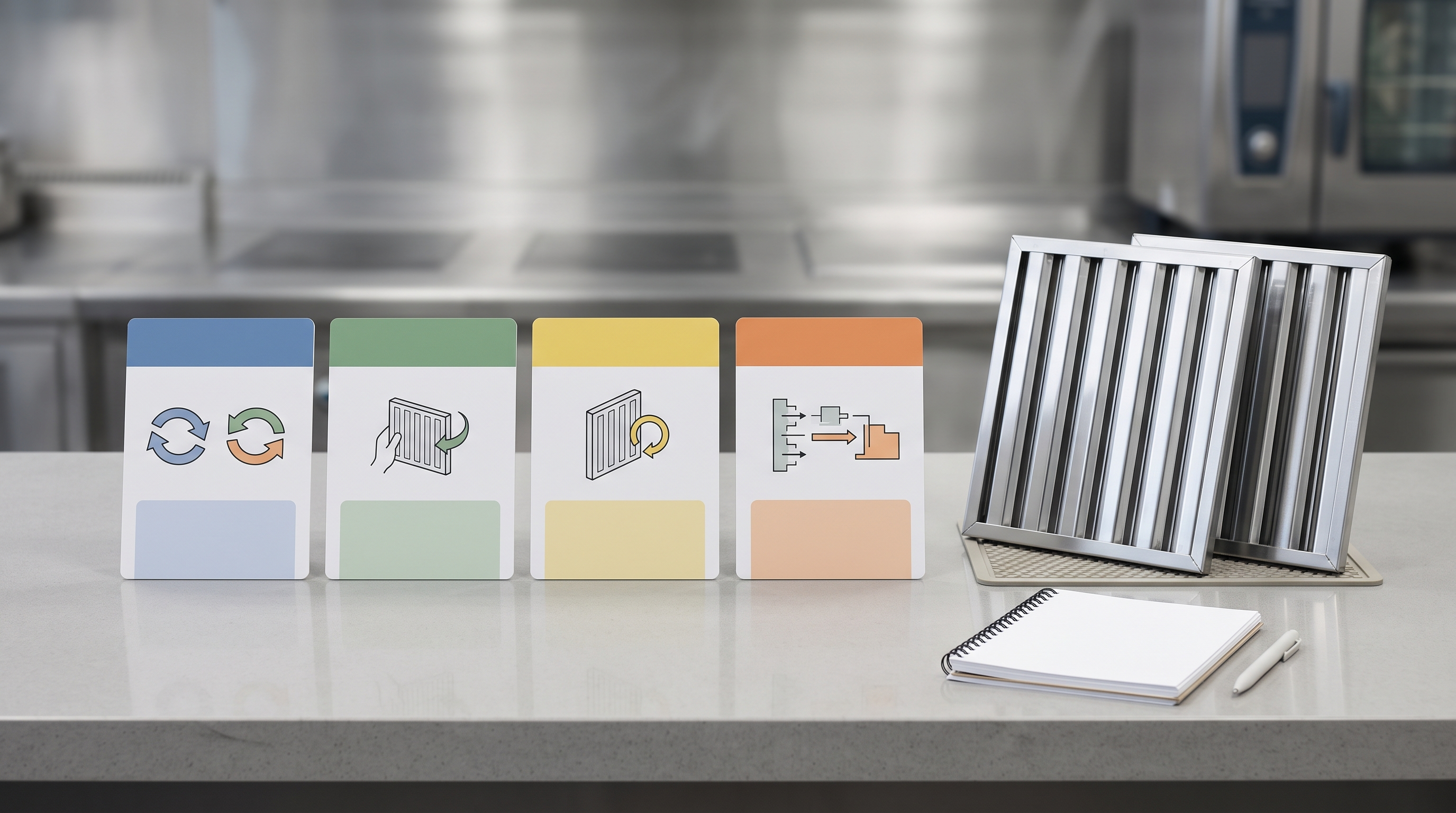
The right program connects the correct filter, inspection trigger, clean inventory, service window and evidence trail.
Define the filter system before choosing a program
“Kitchen filter” can describe different products with different functions and service rules. This comparison addresses grease-removal filters used in commercial cooking exhaust systems. It does not cover HVAC filters, water filters, fryer-oil filtration, fire-suppression components or a complete exhaust-system cleaning program.
Create an asset record for each hood: filter type, manufacturer and model if available, listing or approval information, dimensions, orientation, quantity, condition, installation instructions, cooking equipment served and responsible person. Verify the installed component against approved system documentation. A filter that physically fits an opening is not automatically compatible.
Ontario’s Fire Code includes commercial cooking exhaust requirements and identifies a grease filter or another grease-extraction means within qualifying systems. Code interpretation and the obligations for a particular installation belong with the owner and applicable professionals or authorities, not a blog.
Compare the four filter program models
| Program | Often fits | Main dependency | Primary trade-off |
|---|---|---|---|
| On-site cleaning | Approved cleaning can be completed during a controlled shutdown | Safe location, process, drying and verification before reinstallation | Less rotating inventory but a longer service window |
| Exchange rotation | The kitchen needs clean compatible filters installed promptly | Correct spare set, custody control and off-site cleaning process | Shorter line interruption but more inventory and tracking |
| Replacement-only | Filters are disposable by design or no longer serviceable | Correct approved replacement and waste route | Simple disposition but higher material dependency |
| Hybrid condition-based | Different inspection findings require cleaning, exchange or replacement | Clear trigger criteria and authorized decision maker | Better fit to condition but more governance and records |
No model proves compliance by itself. The program must match the exact system, current legal and authority requirements, manufacturer instructions, cooking load, site procedures, insurer or landlord conditions and qualified service scope.
Use on-site cleaning when the shutdown can absorb the work
On-site cleaning keeps the filters at the premises. It can reduce custody complexity and spare inventory, but the kitchen needs a suitable cleaning area, isolation from food and clean equipment, approved chemical and wastewater controls, drying time and a safe route back to the hood.
The proposal should define who removes and reinstalls filters, how the cooking system is made unavailable when required, how filter orientation is preserved, which surfaces are cleaned, how damage is identified, where residue and wastewater go and what verifies readiness for return to service. Do not let an unapproved wash process become routine merely because it is convenient.
Best fit: a kitchen with a predictable closed period and validated service method. Stop condition: no cooking should proceed with required filters missing, incorrectly installed or in a condition that the responsible qualified person has not accepted.
Use filter exchange when clean compatible inventory must be ready
An exchange program replaces the installed soiled set with a clean compatible set and moves the removed filters into a controlled cleaning cycle. This can shorten the time the hood is out of service. It also introduces inventory, identity and custody risks.
Each filter or set needs a stable identifier tied to size, type, hood and orientation. The provider and kitchen should agree who owns the inventory, minimum spare quantity, acceptance condition, storage, transport, loss or damage handling and what happens when a clean filter fails the site check.
Robinhood Cleaners publishes filter cleaning and exchange among its services. That confirms a public service category, not the fit, credentials, compatibility, territory, cadence, price, documentation or availability for a particular kitchen. Confirm those details in writing before relying on the program.
Use replacement when cleaning cannot restore an acceptable filter
Replacement is not the same as cleaning. A filter may need replacement because it is damaged, distorted, corroded, missing a component, incorrectly sized, not approved for the system or otherwise outside service criteria. The responsible person should use manufacturer and system requirements to make that decision.
A replacement-only program can suit components designed not to be cleaned or sites that hold approved new inventory. The trade-off is material availability and waste. Substituting a similar-looking filter without verifying compatibility can change fit, orientation or performance and create a false sense of completion.
Record the reason for replacement, old asset identifier, new make and model, approval or listing evidence, installation check and disposition route. Do not promise airflow, energy savings, fire-risk reduction or equipment life from a new filter without competent system-specific evidence.
Build a hybrid program around decision triggers
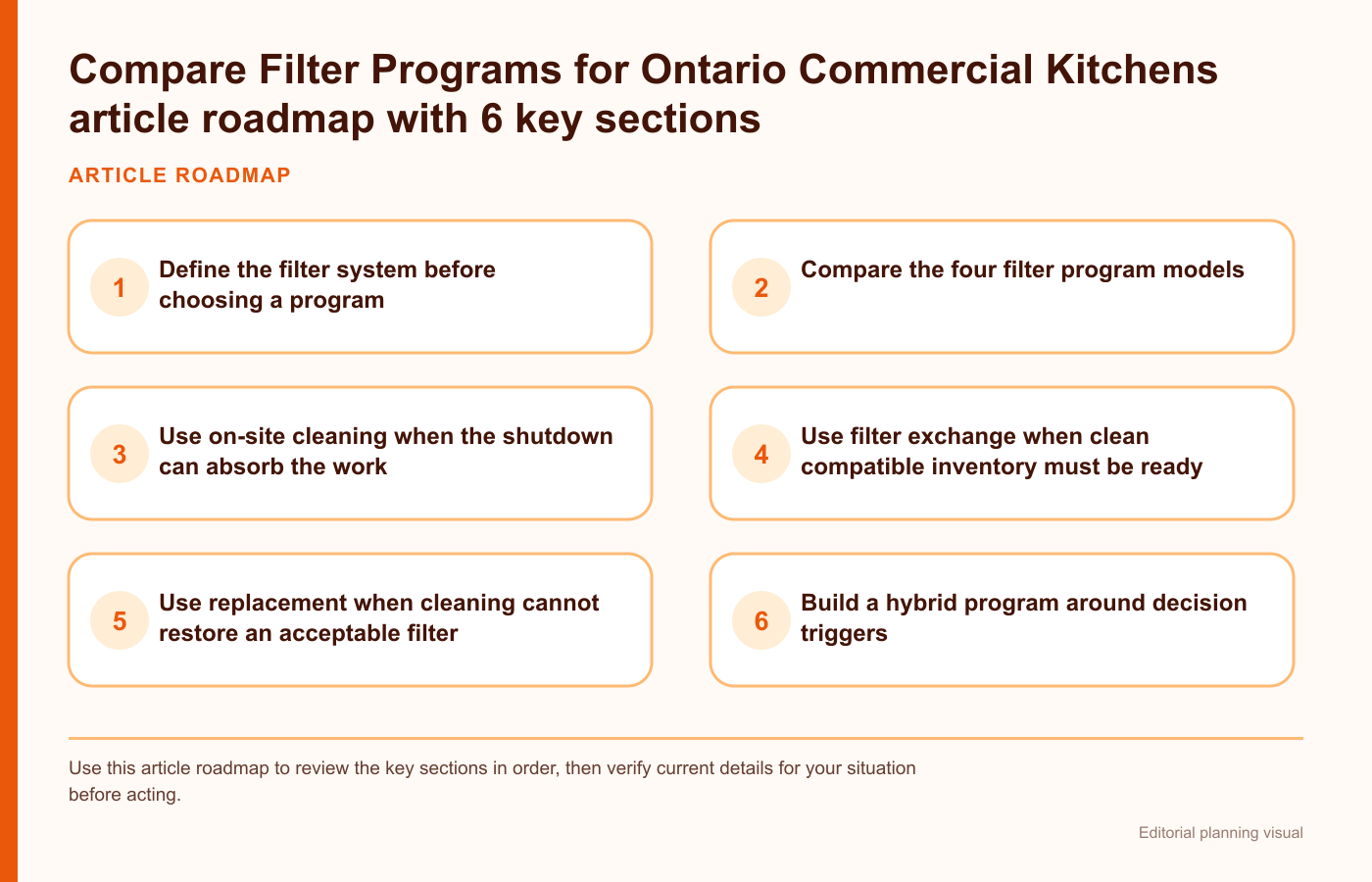
Use this article roadmap to review the key sections in order, then verify current details for your situation before acting.
A hybrid program begins with inspection and sends each filter to one of four outcomes: remain in service, clean on site, exchange for a clean compatible unit or replace. It is useful when kitchens have different hoods, cooking loads or equipment conditions.
The decision tree must be approved by the responsible qualified parties. It can include visible accumulation, damage, missing parts, incorrect fit, service history, manufacturer criteria and authority direction. Avoid asking kitchen staff to make technical judgements outside their training.
- Identify the hood and exact filter set.
- Perform the authorized check at the required interval.
- Apply the approved service trigger and stop conditions.
- Use the specified safe handling and system-isolation process.
- Clean, exchange or replace through an accepted provider.
- Verify identity, condition, orientation and installation.
- Close the log with evidence and the next required review.
Control filter identity, clean storage and availability
An exchange program fails if a clean filter arrives but does not belong to that hood. Build a master list with photos, dimensions, manufacturer information, system location and a unique identifier. Do not rely on handwritten size alone where similar units exist.
Separate clean, soiled, rejected and awaiting-review inventory. Protect clean filters from food contamination, chemicals, impact and moisture. Define the maximum and minimum number of serviceable spares, reorder or repair trigger and emergency contact. If a filter is lost or rejected, the system should identify which cooking operation is affected before the line opens.
Robinhood Cleaners also publishes a broader commercial kitchen hood-cleaning route. Keep the filter-program scope separate from full hood, duct, fan or fire-suppression work unless the proposal explicitly includes and assigns those tasks.
Define the check cadence, record and escalation path
Ottawa Fire Services’ Ontario Fire Code pre-inspection guide says commercial cooking exhaust filters should be checked at intervals not greater than seven days, remain installed while cooking and be cleaned regularly. Operators should verify current requirements and interpretation for their installation with the applicable authority; a check interval is not automatically the same as a cleaning or replacement interval.
Each record should identify date, hood, filter set, person, observed condition, action, removed and installed asset IDs, exceptions, photos if appropriate and sign-off. Keep provider work orders and filter inventory records connected to the kitchen’s own log rather than storing them in separate inboxes.
Escalate missing filters, incorrect fit, damage, heavy accumulation, smoke capture concerns, unusual noise, fire-system impairment or any authority direction through the site’s emergency and maintenance process. Do not improvise repair, bypass an interlock or operate equipment contrary to approved instructions.
Compare filter program proposals on the same evidence
| Proposal field | Question to resolve |
|---|---|
| Scope | Which filters, hoods, cleaning steps, exchanges and replacements are included? |
| Compatibility | Who verifies type, size, listing, orientation and manufacturer requirements? |
| Cadence | What triggers checks and service, and who can change the interval? |
| Inventory | Who owns, stores, tracks and replaces clean spares? |
| Safety | How are shutdown, food protection, chemicals, access and reinstatement controlled? |
| Evidence | What log, photos, asset IDs and exceptions are delivered? |
| Exceptions | What happens after damage, mismatch, missed service or emergency? |
| Commercial terms | Which visits, materials, delivery, disposal, minimums and extra charges apply? |
Verify provider qualifications, insurance, worker coverage and references through appropriate current sources. Do not accept a logo, badge or website statement as the entire verification.
Commercial kitchen filter program mistakes to avoid
- Using one interval for every hood without reviewing load and requirements
- Confusing a required check with automatic cleaning or replacement
- Installing a similar-looking filter without compatibility evidence
- Running an exchange program without clean-inventory control
- Letting unqualified staff remove or alter exhaust components
- Assuming filter service replaces hood-to-fan system cleaning
- Keeping provider invoices without asset-level service records
- Calling a program compliant without authority and system-specific review
Frequently asked questions
Is filter exchange the same as filter replacement?
No. Exchange usually rotates a serviceable clean set for a soiled set that will be cleaned. Replacement removes a filter from service and installs an approved new or accepted substitute.
How often should Ontario kitchen filters be changed?
There is no universal change interval. Confirm required checks, service triggers and replacement criteria from current code, authority, manufacturer, insurer and site evidence.
Can a kitchen wash grease filters in a dishwasher?
Do not assume that method is approved. Verify filter instructions, equipment suitability, food-safety separation, chemical and wastewater rules, and the site’s safe procedure.
Does clean filter documentation prove the whole exhaust system is compliant?
No. Filters are one part of a larger cooking exhaust and fire-protection system. Other inspection, cleaning, maintenance and documentation obligations may apply.
Request a site-specific filter program review
Collect the hood and filter inventory, current requirements, inspection records, cooking profile, service windows and unresolved exceptions. Then contact Robinhood Cleaners through its current official site to ask whether it can support the exact filter system and program model. Verify credentials, territory, scope, compatibility, safety process, inventory, records, price and emergency terms before authorizing service.