Busy lines, roaring fryers, and back-to-back tickets are the heartbeat of a great service. But if the air in your kitchen is smoky, greasy, or stale, performance drops fast. This complete guide shares practical kitchen air quality improvement tips you can use right away—built around NFPA 96–aligned practices and the day-to-day realities of Ontario restaurants.
At a Glance
- What you’ll learn: seven field-tested ways to improve air, reduce smoke, and control odors.
- Why it matters: safer teams, consistent cooking temps, better guest experience, and fewer fire hazards.
- Who this is for: restaurants, food courts, institutional kitchens, QSRs, and catering ops across Ontario.
- How we help: Robinhood Cleaners delivers NFPA 96–aligned kitchen exhaust cleaning, filter cleaning & exchange, exhaust fan cleaning, duct cleaning services, and ventilation system maintenance—24/7 around your schedule.
Quick Answer
If you need fast, effective kitchen air quality improvement tips in All Over Ontario, start with grease control (hoods, filters, ducts), tune the exhaust and makeup air balance, and maintain rooftop fans. Robinhood Cleaners provides NFPA 96–aligned cleaning and ventilation system optimization to help your team breathe easier and cook consistently.
What Is Kitchen Air Quality?
In a commercial kitchen, “air quality” reflects how clean, breathable, and temperature-stable the air is while you cook. Great air quality means less smoke, fewer odors, proper humidity, and comfortable temperatures despite high-heat equipment.
- Core drivers: grease capture, hood and duct cleanliness, exhaust rate, makeup air volume, filtration type, and rooftop fan performance.
- What success looks like: clear sightlines, minimal haze, steady hood capture at peak rush, and team members who aren’t overheating.
- Measured by: hood face velocity, exhaust CFM, CO/NO2/PM levels where applicable, and temperature differentials across the line.
Why Kitchen Air Quality Matters
- Team safety and stamina: Cooler, cleaner air reduces fatigue, improves focus, and lowers accident risk.
- Food quality and speed: Stable temps and low smoke keep grills, fryers, and ovens working predictably, so plates leave the pass faster.
- Fire hazard reduction: Less grease in hoods, ducts, and fans means fewer ignition points—aligned with NFPA 96 guidelines.
- Guest experience: Better odor control in dining rooms, especially open kitchens or food court stalls.
- Compliance and uptime: Clean, balanced systems pass inspections and minimize surprise shutdowns.
How Commercial Kitchen Ventilation Works
Think of your setup as a system: the hood captures, the duct carries, the fan pulls, and makeup air replaces what’s exhausted. Any weak link hurts air quality.
- Hood capture: Canopy hoods rely on proper overhang, baffle filters, and sufficient face velocity to grab smoke and steam.
- Ductwork: Grease-laden vapors condense inside ducts; buildup narrows pathways and invites flare-ups.
- Exhaust fan: The fan provides the “pull.” Worn bearings, slipping belts, and bent blades reduce airflow.
- Makeup air (MUA): Fresh air offsets what you exhaust. Too little makeup air starves the hood; too much creates drafts and comfort issues.
- Filtration and capture devices: Baffle filters, spark arrestors, and rooftop grease containment keep grease where it belongs.

For a deeper look at system balancing, see our in-depth guide on kitchen ventilation optimization and how airflow targets affect capture and comfort across the line.
Kitchen Air Quality Improvement Tips (Ontario-Ready)
Here are seven proven moves you can implement quickly. They’re practical, inspection-friendly, and tailored to busy Ontario kitchens.
1) Keep Hoods and Ducts Truly Clean
- Schedule NFPA 96–aligned cleaning: Base frequency on cooking volume and fuel type (e.g., solid fuel needs more frequent service).
- Target the whole path: Hood plenum, baffle filters, horizontal and vertical ducts, and rooftop fan housing.
- Watch for telltales: Persistent haze, tacky filter frames, and “smoke burps” when dropping food into fryers.
- Action step: Book a routine kitchen exhaust cleaning that documents before/after conditions for compliance.
2) Use the Right Filters—and Swap on Time
- Choose quality baffle filters: They separate grease efficiently and reduce carryover into ducts.
- Set a rotation: Implement a filter cleaning & exchange program so there’s always a clean set on deck.
- Field tip: If filters feel heavy or look matte/tacky after service, they’re holding grease longer than they should.
- Action step: Follow our filter cleaning checklist or consider a managed exchange to lock in consistency.
3) Verify Fan Belts, Bearings, and Blades
- Listen first: Chirps, rumbles, or scraping sounds often signal a slipping belt or bearing wear.
- Inspect safely: Lockout/tagout, then check belt tension, pulley alignment, and blade condition.
- Seasonal reminder: Ontario winters stress rooftop fans—ice load, wind, and freeze/thaw cycles loosen hardware.
- Action step: Add fan belt replacement checks to your monthly walkthrough and quarterly maintenance plan.
4) Balance Exhaust and Makeup Air
- Symptoms of imbalance: Doors hard to open (negative pressure), drafts across grills (too much MUA), or smoke rolling out when lids lift.
- Dial in CFM: Target spec airflow and hood face velocity. Balance across multiple hoods so one line doesn’t starve another.
- Comfort bonus: Proper MUA temp and distribution reduce hot spots at expo and fry stations.
- Action step: Have a technician test pressures and recalibrate dampers during ventilation system maintenance.
5) Capture Grease at the Source
- Use spark arrestor baffles: Especially for solid-fuel cooking; they limit embers and grease carryover.
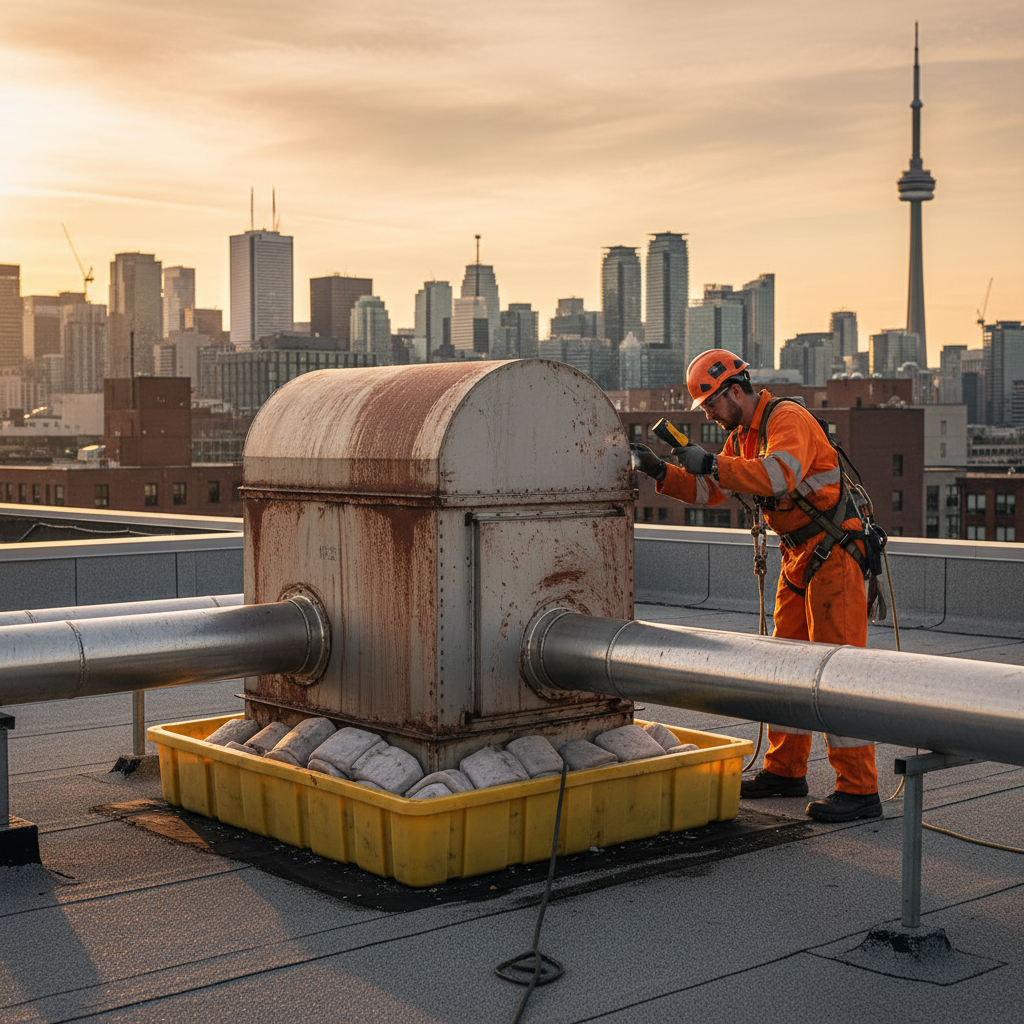
- Install rooftop grease containment: Protects the roof membrane, reduces fire risk, and keeps drains clear.
- Maintain grease traps properly: Overflowing traps add odors fast and can back up under heavy loads.
- Action step: Pair hood cleaning with grease trap service so capture and disposal happen in sync.
6) Power Wash Floors and Adjacent Surfaces
- Why it helps air: Hot, greasy floors off-gas odors and aerosolized residue when disturbed.
- High-impact zones: Under fryers and grills, around dish, and walk-off mats near the back door.
- Action step: Add scheduled power washing to reduce airborne grease and odors between deep cleans.
7) Monitor, Record, Improve
- Set simple KPIs: Hood face velocity readings, filter rotation dates, fan belt checks, grease trap logs.
- Use a one-page log: Track readings by shift and season. Ontario weather swings affect performance.
- Review quarterly: Spot trends and adjust cleaning frequency, filter rotation, and MUA settings.
- Action step: See our high-level overview on air quality improvement for ways to baseline your kitchen.
Want a quick, no-disruption assessment? Our WSIB-insured, NFPA 96–certified team can audit hoods, ducts, fans, and MUA settings off-hours—then align a cleaning and maintenance plan to your rush windows. We serve restaurants across Ontario with quick service in Southern Ontario.
Best Practices & Checklists
Keep it scannable and consistent. Here’s a field-ready checklist our technicians use across busy Ontario kitchens.
Daily Line-Check (5 Minutes)
- Confirm hood capture visually during the first test fire; look for rollback.
- Verify baffle filters are seated correctly and oriented for grease flow.
- Listen for unusual fan noise at startup and peak periods.
- Wipe hood rims and light lenses to reduce sticky film and glare.
- Record any smoke or odor spikes in the log (time and station).
Weekly Tasks
- Rotate filters through a hot-degrease wash or exchange program.
- Power wash floors under fryers and grills; clean floor drains and mats.
- Check rooftop grease containment absorbents and replace as needed.
- Confirm makeup air screens are clear; vacuum dust and debris.
Monthly Tasks
- Inspect fan belts for wear and tension; check pulleys and set screws.
- Open select duct access panels (if safe) to spot-check residue trends.
- Test for negative pressure at doors; adjust MUA or dampers if needed.
- Review and sign off the air quality log; plan adjustments for the next month.
Quarterly / Seasonal
- Schedule professional kitchen exhaust cleaning for hoods, ducts, and fans.
- Complete a ventilation balance test—especially after menu or equipment changes.
- Winterize rooftop components before freeze/thaw; inspect after major storms.
- Audit grease trap service intervals against actual volume and odor reports.
Process Table: Maintenance Cadence by Cooking Volume
| Kitchen Profile | Hood/Duct Cleaning | Filter Rotation | Fan/Belt Check | Grease Trap Service |
|---|---|---|---|---|
| High-volume fry/grill (QSR) | Every 1–2 months | Weekly or exchange | Monthly | Every 1–2 weeks |
| Full-service, mixed menu | Every 2–3 months | Biweekly | Monthly | Monthly |
| Institutional/low-grease | Every 3–4 months | Monthly | Quarterly | Monthly–Quarterly |
Note: Use this as a starting point. Actual frequency should match inspection findings, volume, and fuel type in your Ontario location.
Tools & Resources
Simple tools keep teams consistent between deep cleans. Here’s what works on the line and on the roof.
Back-of-House Essentials
- Digital anemometer for quick hood face velocity checks.
- High-temp degreaser and non-scratch pads for baffle filters.
- Color-coded log sheets for filters, fans, and grease traps.
- Flashlight and inspection mirror for duct access panels.
Rooftop Kit
- Non-slip shoes, harness where required, and lockout/tagout kit.
- Grease containment absorbents and drip pans sized for your fan model.
- Spare belts and a belt-tension gauge matched to fan specs.
- Weather covers for winter; check after storms along the 401 corridor.
If you want a structured, step-by-step plan for tuning airflow, our hands-on guide to ventilation optimization explains test points, readings, and practical fixes your team can maintain.
Local Tips
- Tip 1: Planning service near the 401, QEW, or 403? Book off-hours to avoid traffic delays and let teams clean hoods, ducts, and fans without impacting prep.
- Tip 2: Winter in Southern Ontario brings ice and wind on flat roofs. Schedule fan inspections after storms and before deep freezes to protect belts and bearings.
- Tip 3: Food courts and open kitchens along busy shopping corridors benefit from filter exchanges during mall off-hours—our 24/7 crews can coordinate with security for access.
IMPORTANT: These tips align with Robinhood Cleaners’ focus on kitchen exhaust cleaning, filter exchange, fan belt replacement, and ventilation maintenance across Ontario.
Mini Case Studies (Ontario)
Real kitchens, real fixes. Names withheld for privacy—patterns matter more than logos.
QSR Line in the GTA
- Problem: Persistent smoke at the fry bank during dinner rush.
- Findings: Clogged baffle filters and slipping rooftop fan belt reduced capture.
- Fix: Filter exchange program + belt replacement + minor damper tweak.
- Result: Clear sightlines at peak and better odor control in dining room.
Institutional Kitchen in Southwestern Ontario
- Problem: Heat load at the griddle made the morning line uncomfortable.
- Findings: Undersized makeup air diffuser shot cold air at expo; hood face velocity was inconsistent.
- Fix: Rebalanced MUA, adjusted diffuser, and deep-cleaned ducts to restore airflow.
- Result: Cooler station temps and steadier cook times.
Food Court Operator (Golden Horseshoe)
- Problem: Odor complaints migrating into shared seating.
- Findings: Grease trap overdue; rooftop containment saturated; filters near end-of-life.
- Fix: Synchronized hood cleaning with grease trap service and installed fresh absorbents.
- Result: Noticeable odor reduction and smoother health inspection.
FAQ
-
How do I know my hood isn’t capturing properly?
Watch for smoke rolling out when you lift lids or drop fries, haze lingering after rush, and hot spots along the line. Check baffle seating, clean filters, and verify fan belt tension. A quick face velocity test with a handheld meter helps confirm capture. If problems persist, schedule a professional hood and duct inspection.
-
What’s the fastest way to improve kitchen air quality this week?
Start with clean filters and a proper exchange rotation, confirm the rooftop fan belt is tight, and do a power wash under grills and fryers. These three steps often reduce haze and odors immediately. Then book an NFPA 96–aligned hood and duct cleaning to reset the system.
-
Is ventilation balance really that important?
Yes. Without the right balance between exhaust and makeup air, hoods lose capture and doors can be hard to open due to negative pressure. Balanced airflow stabilizes temperatures, improves comfort, and prevents smoke migration. An airflow check and damper adjustment can make a big difference fast.
-
When should I schedule professional exhaust cleaning?
Base it on cooking volume, menu, and fuel type. High-volume frying and solid-fuel operations often need service every one to two months. Full-service restaurants may stretch to two to three months. Use inspection findings and your air quality log to set the right cadence.
-
Can better air quality lower fire risk?
It can. Cleaner hoods, ducts, and fans remove fuel sources, while capture improvements limit grease carryover. Following NFPA 96 guidelines and keeping filters rotated, ducts clean, and fans maintained reduces ignition points and helps pass inspections.
Conclusion & Next Steps
- Key Takeaways:
- Grease control and filter rotation are your fastest wins.
- Fan health and airflow balance drive capture and comfort.
- Logs, seasonal checks, and synchronized services create durable results.
- Action Steps:
- Start a filter exchange rotation and log today.
- Book a roof inspection to verify belts, bearings, and containment.
- Schedule NFPA 96–aligned hood and duct cleaning during your slow window.
Ready for a plan tailored to your line, menu, and hours? Our WSIB-insured, NFPA 96–certified crews work 24/7 across Ontario, with quick response in Southern Ontario. Let’s align cleaning and maintenance to your rush windows so your team breathes easier and cooks faster.
Related Guides
- Ventilation balance checklist for multi-hood kitchens
- Seasonal rooftop fan care (Ontario winterization)
- Filter exchange programs: how to keep sets in rotation
- Grease trap odor control playbook for shared seating areas